
The Ashanti Region is recording worrying cases of suicide attempts, with health authorities warning that the reported figures could represent only a fraction of the real situation.
For the first six months of 2025, the region recorded 66 attempted suicides and three completed suicides, according to the Ashanti Regional Director of Health Services, Dr Fred Adomako Boateng.
He says the figures highlight the need for stronger surveillance, early intervention and community-based suicide prevention.
“These are the reported figures, and it’s just the tip of the iceberg. We have a lot that we cannot and have not recorded.”
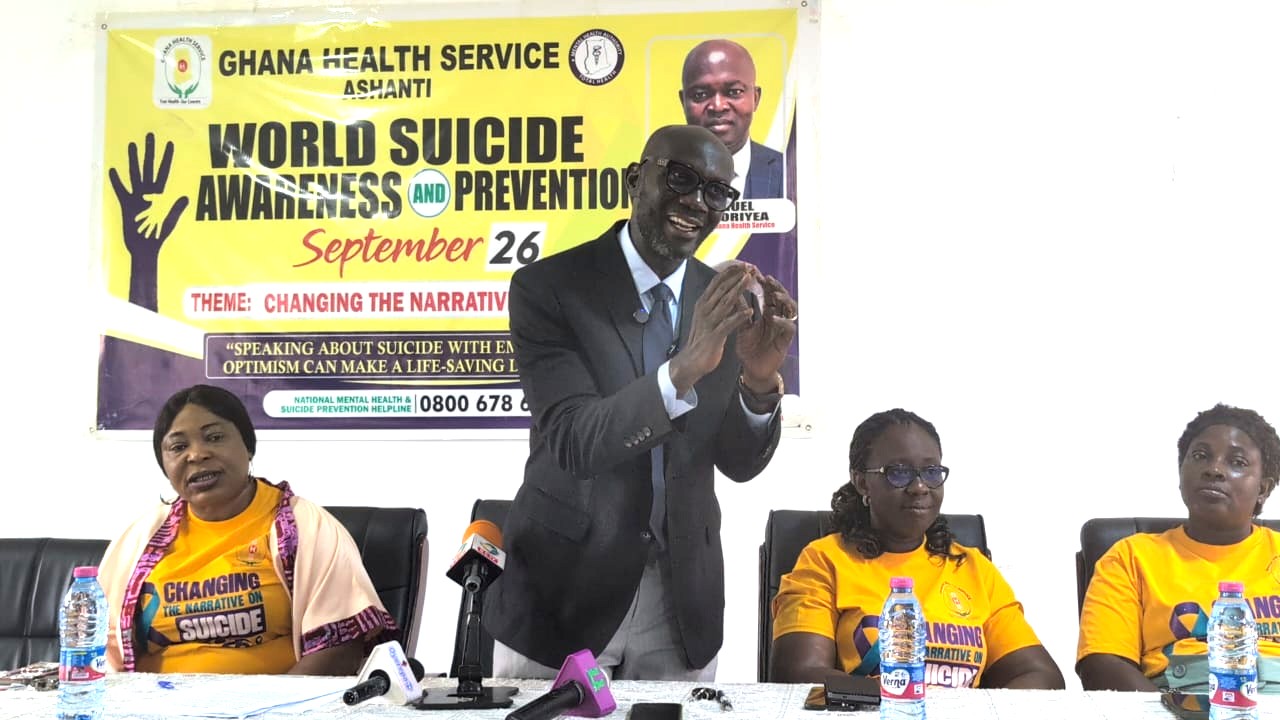
Addressing the media in Kumasi, Dr Adomako Boateng said although increased reporting may partly explain the rise in cases following Ghana’s decriminalisation of attempted suicide in 2023, the trend points to a deeper public health concern.
“The increase may partly reflect improvement in reporting following Ghana’s decriminalisation of attempted suicide in 2023. But improved reporting does not explain everything. The evidence indicates that we are dealing with a genuine and serious public health challenge.”
National data also points to a worrying gap in access to professional support.
The 2023 Ghana STEPS survey found that 3.8 percent of adults aged 18 to 69 reported having considered attempting suicide within the previous 12 months.
But only 9.1 percent of those who had considered suicide sought professional help.
Dr Adomako Boateng said the low level of help-seeking should concern everyone.
“It means that the majority of us who reach the point of considering suicide do not have access to professional support.”
He said young people require particular attention.
“Academic pressure, unemployment, financial difficulties, relationship problems, family conflict, substance use, social isolation, cyberbullying and pressures associated with social media are among the factors identified as contributing to psychological distress.”
Dr Adomako Boateng says cultural expectations that discourage young men from expressing emotional pain must also be confronted.
“Our challenge is to create a society in which a person can say, ‘I am not coping,’ without being mocked, condemned or dismissed. It is not a weakness to say, ‘I need help.”
He is urging parents, teachers, health workers, religious and traditional leaders, as well as community leaders, to learn to recognise early warning signs and respond before situations escalate.
The Ghana Health Service says suicide prevention cannot be left to psychiatric hospitals alone.
It is therefore seeking stronger mental health services at the primary-care and community levels, including early identification, counselling, referral, treatment, follow-up and continuity of care.
Dr Adomako Boateng is also calling on health managers and frontline workers to improve the reporting and documentation of suicide-related incidents.
“If suicide attempts are concealed, if families are afraid to report them, or if health facilities fail to document cases properly, we cannot accurately identify where the problem is greatest or where resources are most urgently required.”