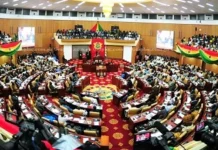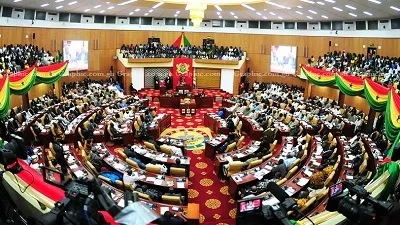

Parliament has rescinded the passage of the Human Sexual Rights and Family Values Bill, popularly known as the anti-LGBTQ+ Bill, to allow for a second consideration to reconcile inconsistencies in the document.
The motion to rescind the passage was moved by the Majority Leader, James Agalga, on Monday, November 10, 2026.
The move reverses the House’s approval of the Bill at the third-reading stage — the stage at which a Bill is deemed passed — and reopens it for correction before it can be transmitted to the President for assent.
Mr Agalga had foreshadowed the move last week. Speaking on Joy News on Wednesday, November 4, he said mistakes in calculating penalty units could create serious problems when courts apply the proposed law.
“For instance, how to compute penalty units was completely done in error, in some cases,” he said. “The penal provisions are not aligned. They are not aligned properly.”
He explained that the penalties must align with existing legislation, and that leaving them as they are would cause trouble once courts begin applying the law.
“Otherwise, the bill as it stands in this current form would have serious challenges when it comes to implementation.”
Mr Agalga stressed that the corrections are technical, not a rewrite of the Bill’s intent.
“So, not much of substance would change,” he said.
He also rejected suggestions that the delay reflected a change in President John Dramani Mahama’s position on the Bill.
“Contrary to all the wild speculations that the President has shifted goalposts and all that. No, he hasn’t,” he said. “It’s Parliament’s work. We have the duty of enacting laws.”
He has assured that the corrected Bill will reach the President this month, before Parliament rises. Asked whether that would happen, he replied: “Absolutely.”
What Rescission Means
Under Parliament’s Standing Orders, the House cannot reopen a question it has already settled in the same session except on a substantive Motion for rescission.
By carrying Mr Agalga’s motion, the House has cancelled its decision to read the Bill a third time. That returns the Bill to the stage just before third reading and opens the door to what the rules call a second consideration — where a member may move to delete, amend or add a provision.
Once the corrections are made, the Bill will have to be read a third time again before the Clerk can transmit it to the President. Under Article 106 of the Constitution, the President has seven days after receiving a Bill to notify the Speaker whether he assents or refuses, unless he refers it to the Council of State.
Speaker Alban Bagbin, opening the current meeting last Tuesday, had vowed to name any MP who obstructs the Bill’s passage, and reaffirmed his intention to complete it during this meeting.
Background: A Five-Year Journey
The Bill has travelled a long and controversial path:
2021: The Bill was first introduced in Parliament as the Promotion of Proper Human Sexual Rights and Ghanaian Family Values Bill, 2021, by eight MPs led by Sam Nartey George. It had its first reading on August 2, 2021, second reading on July 5, 2023, and was considered by the Legal and Parliamentary Affairs Committee.
February 28, 2024: The 8th Parliament passed the Bill unanimously. It prescribed custodial sentences for same-sex conduct and for promotion, sponsorship or support of LGBTQ+ activities.
The passage drew international condemnation and warnings about its impact on Ghana’s development funding. Human rights groups, including a coalition of 18 civil society groups known as the “Big 18”, opposed it from the beginning.
Then-President Nana Akufo-Addo declined to assent, pending Supreme Court challenges filed by broadcaster Richard Dela-Sky and researcher Amanda Odoi, who argued the Bill violated constitutional rights.
In December 2024, the Supreme Court dismissed the challenges as premature because the Bill had not yet become law. The Bill subsequently lapsed with the dissolution of Parliament ahead of the 2024 general election.
2025: In March 2025, a group of 10 MPs reintroduced it as a Private Member’s Bill, the Human Sexual Rights and Family Values Bill, 2025. President Mahama said while he supported the principle of the legislation, he would prefer it to be introduced as a government Bill rather than a Private Member’s Bill.
President Mahama has publicly stated his position: “I believe in the principles and values that only two genders exist — man and woman. And that marriage is between a man and a woman.”
May 29, 2026: Parliament passed the revived version again. The core provisions remained largely unchanged — up to three years’ imprisonment for persons who engage in homosexual relations, and three to five years for promotion, sponsorship or intentional support of LGBTQ+ activities — but the new version included exemptions aimed at protecting certain professional duties.
The passage was immediately followed by controversy. Speaker Bagbin said the passage had taken him by surprise and directed the House to revisit the process to achieve bipartisan approval. The Minority opposed amendments relating to professional services, arguing they weakened the Bill.
Parliament went into recess in July without resolving disputes over the punishment provisions, leaving the Bill in limbo.
June 1, 2026: Three days after the vote, President Mahama, speaking at Chatham House in London, said the Attorney-General and the Presidency’s legal team would check the Bill before advising him on assent, and that if there were substantial issues, he would return it to Parliament.
That check, and Parliament’s own review, identified the inconsistencies now being corrected.
With Monday’s rescission, the Bill is back before the House for second consideration. If Parliament completes the corrections as promised, the Bill will be passed again and sent to President Mahama — bringing Ghana’s most divisive Bill in recent years to its final test: presidential assent.