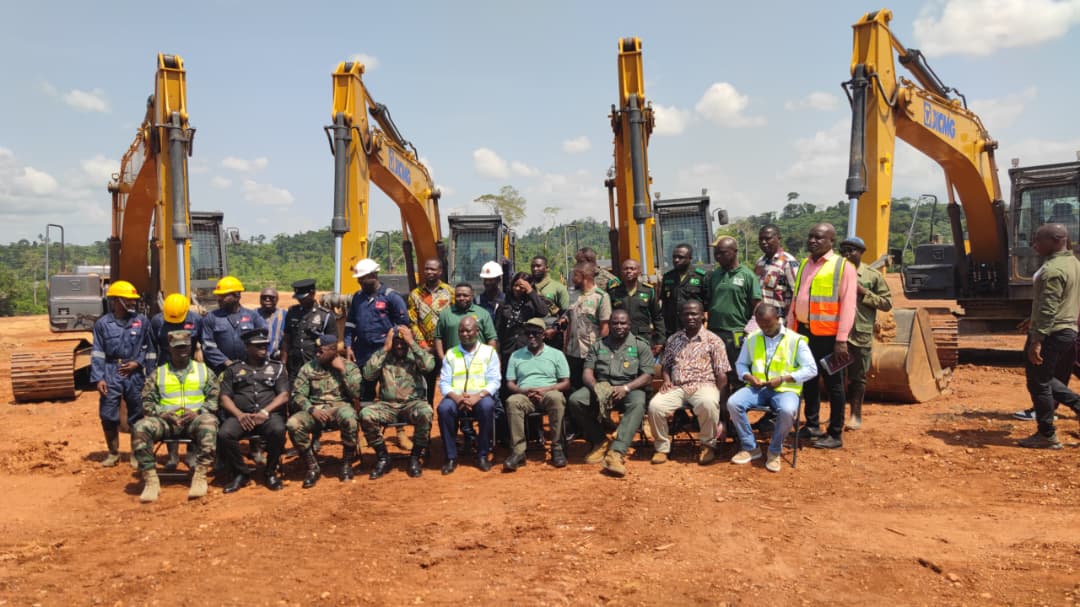

The Ghana Gold Board (GoldBod), in partnership with the Ghana Armed Forces, has successfully reclaimed 50 hectares of degraded land within the Tano-Nimiri Forest Reserve, marking a major step in efforts to restore forests devastated by illegal mining.
The first phase of the reclamation project, carried out by the 14 Engineer Brigade of the Ghana Armed Forces, has been completed and the land formally handed over to GoldBod. The Board will subsequently transfer the area to the Forestry Commission for reforestation, ecological restoration and long-term protection.
Initiated by GoldBod as part of its Corporate Social Responsibility commitments, the project involved extensive engineering works to reclaim abandoned mining pits, restore degraded landscapes, reconstruct access infrastructure and establish a Forward Operating Base to support protection of the forest reserve.
Representing GoldBod Chief Executive Officer Sammy Gyamfi, Esq., Deputy Director of Mining Operations James German described the occasion as an important demonstration of how mining institutions and environmental regulators can work together to reverse environmental degradation.
He noted that the intervention represented a practical expression of the Board’s commitment to responsible mining and environmental stewardship.
Reflecting on an earlier reconnaissance visit to the site, Mr German recalled that the condition of the forest reserve had been deeply troubling, and observed that the transformation achieved through the reclamation works demonstrated what could be accomplished through institutional cooperation, technical expertise and a shared commitment to environmental restoration.
He stressed that mining and environmental stewardship must no longer be treated as competing priorities, insisting that responsible mining must support environmental restoration and deliver lasting benefits to the country and affected communities.
In a detailed technical presentation, the Commander of the 14 Engineer Brigade, Brigadier General Richard Kinney, outlined the scale of engineering operations undertaken in Forest Reserve Compartment 161.
Using a site map prepared to a scale of 1:100,000, he explained that the engineering team identified and classified ten major mining pits within the affected area, alongside several smaller excavations. The abandoned pits contained substantial volumes of stagnant water, with some reaching depths of approximately 20 feet and widths ranging between 30 and 50 metres.
To ensure a systematic approach, the ten major pits were numbered and zoned to guide the reclamation process. The Brigade’s initial operations involved dewatering and covering the abandoned pits, followed by extensive earthworks to fill the excavations, reshape the landscape and establish appropriate ground slopes to minimise erosion during rainfall.
The reclamation process also required specialised soil-stabilisation techniques, particularly in areas containing substantial quantities of waterlogged mud. The muddy material was removed and allowed to dry, while dry soil was introduced and mixed with the existing material to establish a stable foundation before additional soil and topsoil were applied.
The Brigade also reopened watercourses that had been blocked by illegal mining activities to facilitate the discharge of accumulated water and restore natural water flow within the area. Heavy-duty earthmoving equipment was deployed throughout the operation to facilitate the filling of the pits, stabilisation of the ground and restoration of the degraded landscape.
Before-and-after drone images presented during the ceremony demonstrated the transformation of the affected compartment, showing the abandoned mining pits before the intervention, the progress of the reclamation works and the landscape following completion.
Brigadier General Kinney identified access to Compartment 161 as one of the major challenges encountered before the commencement of the reclamation exercise. Following flooding earlier in the year, eight bridges along the access route required reconstruction to facilitate the movement of personnel, construction materials and heavy engineering equipment to the project site.
The Brigade successfully reconstructed all eight bridges and cleared and extended most portions of the 13.6-kilometre access road. These interventions restored vehicular access to the remote forest compartment and provided the logistical support necessary for the execution of the reclamation works.
Persistent heavy rainfall also presented significant operational challenges, frequently saturating the ground and making earthmoving operations difficult. Despite these conditions, Brigadier General Kinney said the officers, soldiers and supporting personnel demonstrated exceptional determination and perseverance, enabling the Brigade to achieve its targets within the originally envisaged timeframe.
Beyond the physical restoration of the land, the project included the construction of a Forward Operating Base to support the continuous monitoring and protection of the forest reserve.
The facility comprises ten prefabricated containers and is designed to accommodate ten Forestry Commission personnel who will be deployed to the area. According to Brigadier General Kinney, the facility has been equipped with essential infrastructure to ensure the comfort and welfare of personnel stationed at the remote location, including a reliable water supply, borehole facilities, a solar-powered electricity system, washrooms and a kitchen.
A roofing structure was also installed across the containers to provide shade and a comfortable resting area, while chain-link fencing was provided around the base as an initial layer of security. The Forward Operating Base is expected to serve as an operational centre for personnel responsible for monitoring and safeguarding the reclaimed forest.
Addressing the gathering, James German underscored the importance of looking beyond the completion of the engineering works to ensure that the reclaimed land regains its ecological value.
He explained that responsible mining under the Ghana Gold Board Act must go beyond compliance with laws and regulations and be demonstrated through practical interventions that protect the environment, improve mining practices and create lasting benefits for the country.
He outlined an integrated approach to responsible mining involving geological knowledge, environmental safeguards, effective monitoring and sustainable land rehabilitation.
Mr German described the Tano-Nimiri intervention as a practical demonstration of the importance of institutional cooperation, highlighting the collaboration among GoldBod, the Ministry of Defence, the Ghana Armed Forces, the Forestry Commission, regulatory agencies, the surrounding community and Samatex.
He particularly commended the 14 Engineer Brigade for its technical expertise and commitment, noting that the reclamation exercise required considerably more than simply moving earth from one location to another. He explained that proper reclamation involved careful consideration of topsoil, ground stability, drainage and landscape design to ensure that rainfall would not wash away the restored soil.
The ultimate objective, he said, was to ensure that over time the reclaimed area would blend naturally with the surrounding forest. He also described the project as a pioneering intervention in which a reclaimed forest area had been complemented by a dedicated Forward Operating Base to prevent the recurrence of illegal mining activities.
A major highlight of Mr German’s address was the emphasis on the long-term responsibility of the Forestry Commission in ensuring the success of the intervention.
He disclosed that the arrangement with the Forestry Commission extends over a ten-year period, providing a framework for sustained restoration and monitoring beyond the initial engineering works. He stressed that while the reclamation of the degraded land represented the most resource-intensive stage of the intervention, the subsequent ecological restoration would be equally important.
The Forestry Commission will undertake tree planting and other restoration activities to facilitate the recovery of the forest ecosystem. Mr German noted that the true success of the intervention would not be determined solely by the number of hectares reclaimed but by the survival and growth of planted vegetation, the stability of the restored landscape and the recovery of the forest ecosystem over time.
He commended the Forestry Commission for its technical contribution and collaboration, as well as the regulatory agencies that participated in the initial reconnaissance and assessment of the project area.
While celebrating the successful completion of the engineering works, Brigadier General Kinney cautioned that the long-term success of the intervention would depend largely on the protection and conservation of the reclaimed land.
He warned that areas previously affected by illegal mining remained vulnerable to renewed encroachment, stressing that the completion of reclamation works alone did not guarantee the long-term protection of the forest.
The Brigade Commander therefore strongly advocated a sustained and visible presence of the Forestry Commission in the reclaimed area. He identified regular patrols, consistent monitoring and early detection of illegal activities as critical measures to prevent renewed degradation.
He cautioned that failure to secure the reclaimed land could render the resources, time and effort invested in the project ineffective. His warning reinforces the importance of the Forestry Commission’s role in ensuring that the restored 50 hectares are protected against further encroachment and illegal mining.
Brigadier General Kinney expressed appreciation to the Military High Command for the guidance, direction and support provided throughout the project. He also acknowledged GoldBod’s leadership for the confidence placed in the Ghana Armed Forces and its support towards the successful execution of the national assignment.
The Forestry Commission was commended for its technical input and collaboration in assessing the reclaimed areas for reforestation. Management of Samatex was also recognised for its assistance and cooperation, alongside the security agencies, traditional authorities, opinion leaders, surrounding communities and other stakeholders who contributed to the successful execution of the project.
The Tano-Nimiri intervention represents more than the reclamation of degraded land. It demonstrates the importance of institutional collaboration in addressing the environmental consequences of illegal mining.
Through its partnership with the Ministry of Defence and the 14 Engineer Brigade, GoldBod has supported a practical environmental restoration initiative involving specialised engineering, infrastructure reconstruction, land rehabilitation and preparations for sustained forest protection.
The handover from the 14 Engineer Brigade to GoldBod, followed by the subsequent transfer to the Forestry Commission, establishes a framework for the continued restoration and conservation of the reclaimed area.
The project reinforces GoldBod’s commitment to ensuring that efforts to harness Ghana’s mineral resources go hand in hand with environmental responsibility and the protection of natural resources. The restoration of the 50 hectares at Tano-Nimiri is an important step towards reclaiming Ghana’s natural heritage and preserving the environment for generations yet unborn.
By Ebenezer Atiemo