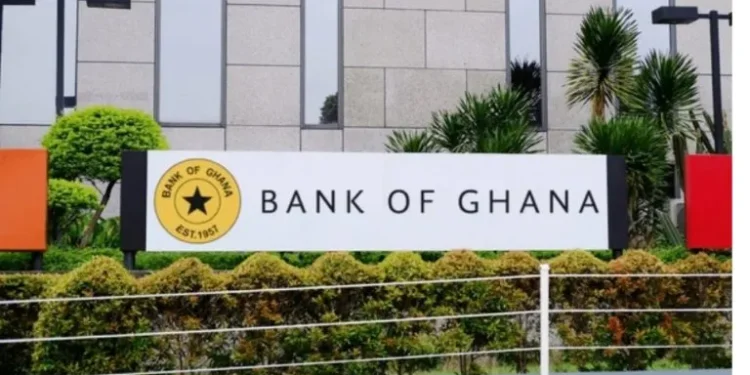

Governor of the Bank of Ghana (BoG), Dr. Johnson Pandit Asiama, has disclosed that the central bank will begin a foreign exchange (FX) intermediation under the Domestic Gold Purchase Programme.
The Programme, earmarked for October this year, according to Dr. Asiama, plans to sell up to US$1.15 billion to the market.
The sales will be conducted on a spot basis through twice-weekly, price-competitive auctions open to all licensed banks.
The Governor, speaking at a meeting with heads of commercial banks in Accra Tuesday, October 7, 2025, noted that there will be no special conditions or earmarked allocations to ensure transparency for all market participants to be treated fairly.
“Beginning October 2025, the Bank of Ghana will commence foreign exchange (FX) intermediation under the Domestic Gold Purchase Programme, with plans to sell up to US$1.15 billion for the month. These sales will be conducted on a spot basis through twice-weekly, price-competitive auctions open to all licensed banks,” he said.
Aside from improving price discovery, the initiative also aims to deepen the interbank FX market and stabilise the cedi.
Also, the Governor indicated that monthly auction volumes may be adjusted based on market developments, but the overarching goal remains to enhance transparency and reduce volatility in the forex market.
Beyond FX management, the central bank is urging commercial banks to expand support for small and medium enterprises (SMEs) and agribusinesses, which are critical to economic growth.
The BoG also encouraged banks to develop export-oriented financial products, use local insurance companies for import coverage to retain forex within the country, and consider public listings to strengthen capital and promote transparency.
The Domestic Gold Purchase Programme, launched to use locally mined gold to build reserves, is part of the BoG’s broader strategy to reduce reliance on foreign currency and support long-term exchange rate stability.