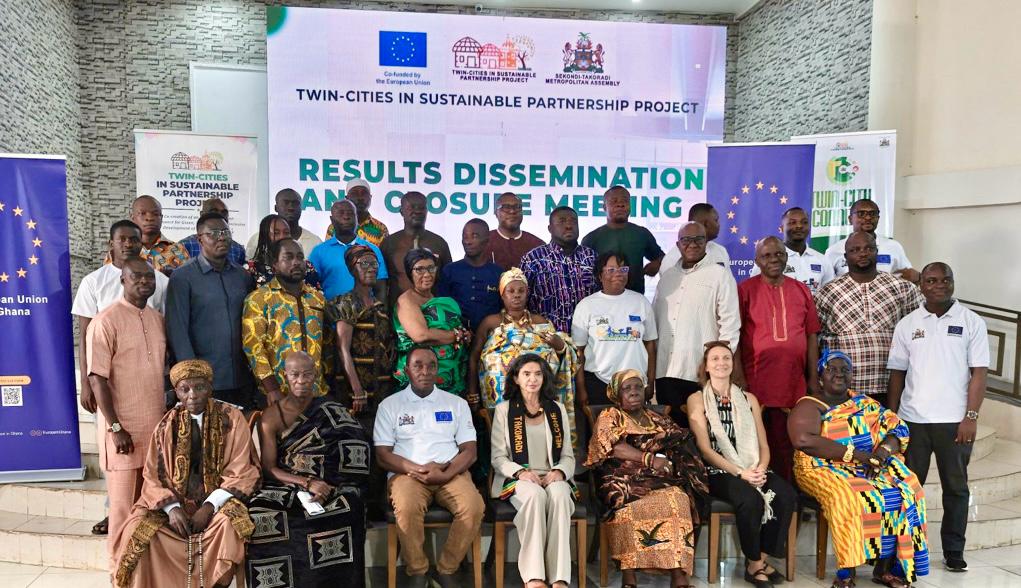

The European Union has hailed the Sekondi-Takoradi Metropolitan Assembly (STMA) for what it describes as a model in sustainable development, following the completion of a €3m Twin-Cities in Sustainable Partnership Project (TCSPP).
Launched in 2022 and co-funded by the Municipality of Palermo in Italy, the initiative has reached more than 13,000 residents. It has created jobs, supported vulnerable households, improved sanitation and helped embed climate resilience in the Western Region.
At a closing ceremony in Takoradi, the EU’s Head of Cooperation in Ghana, Silvia Severi, said the project was proof that “sustainable development is not an abstract idea — it is about real people, real lives, and real change”.
She pointed to “impactful stories” ranging from students and artisans to fisherfolk and families who had benefited from new skills training, household toilets and social enterprises. “The project may officially close today,” she said, “but it is only the beginning.”
Tangible shifts
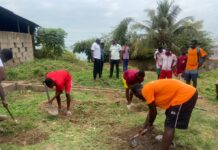
The impact is visible across the metropolis. Three new adolescent health centres have opened, more than 10,000 fruit trees have been planted to strengthen food and climate security, and eco-friendly ovens are helping over two dozen fishmongers cut costs while reducing emissions.
Perhaps most striking is the transformation in sanitation. For years, open defecation blighted coastal communities in Sekondi-Takoradi. But with 500 household toilets constructed under the scheme, Mayor Frederick Faidoo says cases of sanitation-related illnesses have dropped by a quarter.
“This intervention has significantly reduced open defecation,” he noted, adding that training provided to unemployed youth, prison officers and even inmates in biodigester toilet construction has created new livelihood opportunities.
Culture and revenue gains
The project also turned to culture and creativity as economic drivers. Dozens of local artists received capital to showcase their work at international festivals in both Ghana and Italy. At the same time, improved fiscal management has helped STMA boost its internally generated funds more than tenfold since 2021 — strengthening local autonomy and reducing dependence on central government.
“The project has delivered practical solutions in urban governance, climate resilience and livelihoods,” Mr Faidoo said, adding that his administration is drafting a sustainability plan to protect the gains.
Social inclusion and resilience
Beyond infrastructure and economics, the TCSPP put social inclusion at its core. Female-headed households benefited from urban agriculture and livelihood programmes, while gender-based violence survivors gained new channels for reporting and support.
There were breakthroughs in education too. Teenage mothers who had dropped out of school were reintegrated, with several now progressing through senior high school. Seventy other school dropouts were also brought back into the classroom.
Project coordinator Isaac Aidoo said these outcomes showed that “culturally sensitive and inclusive strategies” could reshape communities. But he cautioned that sustaining progress would require deeper alignment with government policies and continued collaboration with civil society.
A legacy to build on
As the EU-funded chapter closes, Sekondi-Takoradi is left with more than new toilets, trees or enterprises. The project has reshaped the city’s approach to governance — making inclusion, resilience and sustainability central to urban planning.
For residents who showcased new businesses and testified to life-changing interventions, the bigger challenge now is ensuring momentum is not lost. The Twin-Cities project may have ended on paper. But for Sekondi-Takoradi, its legacy is still being written.