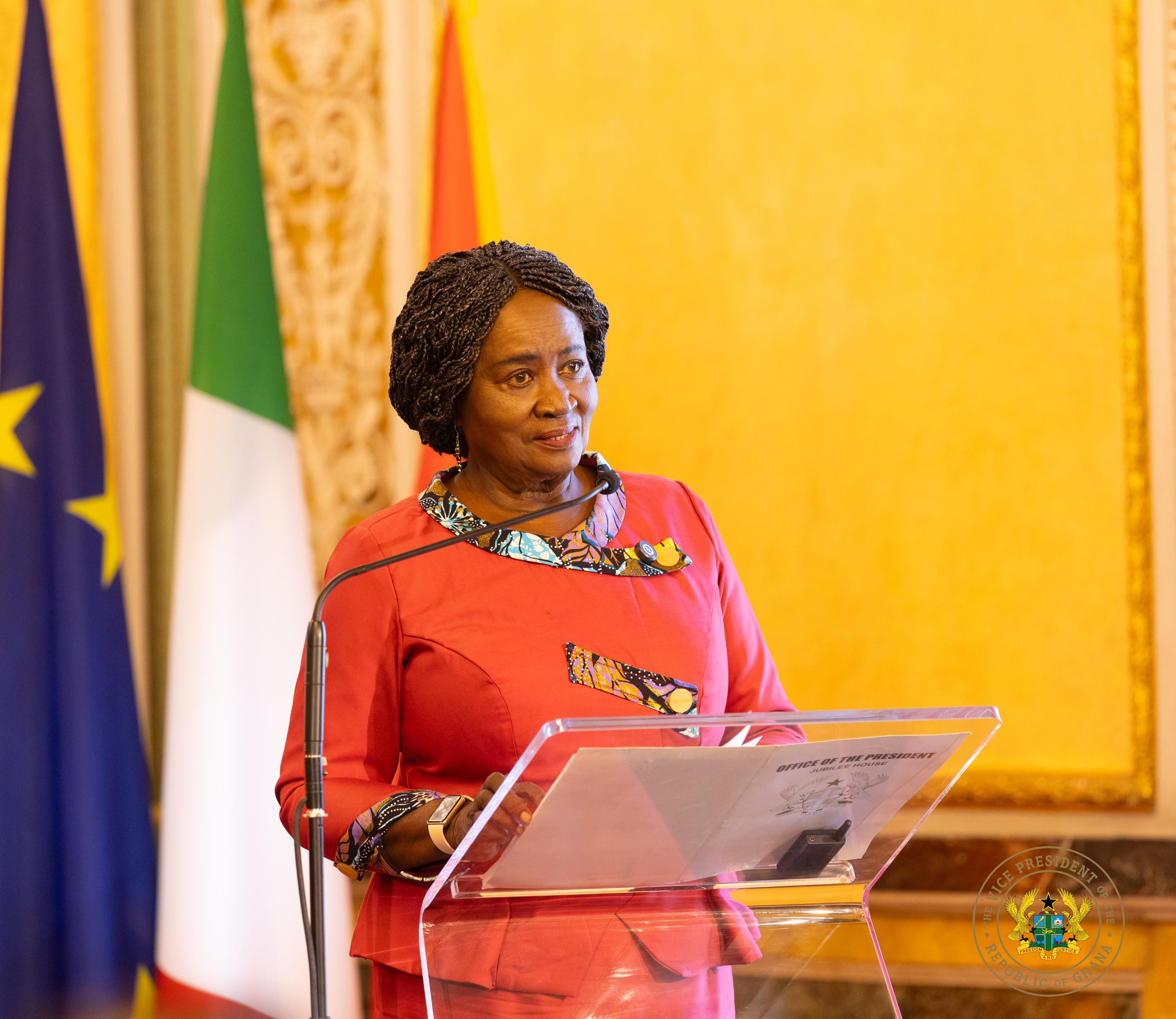

The Vice President, Prof Jane Naana Opoku-Agyemang has highlighted Ghana’s efforts at creating jobs for the growing number of youth in the Country.
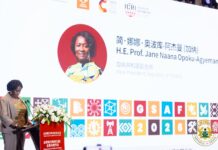
Delivering the Keynote Address at the Africa Growth and Opportunity–Research in Action (AGORA) Conference in Palermo, Italy on November 3, 2025, Prof Opoku-Agyemang cited the 24-hour economy policy among others, as measures to address unemployment.
“When President Mahama returned to office, he set out a clear, practical vision — to make Ghana’s economy more productive, more competitive, and more inclusive. That vision is encapsulated in our flagship policy: the 24-Hour Economy framework. This idea is not about any citizen working endlessly; it is about how we want to organize the economy to function continuously and efficiently, powered by stable energy, modern logistics, skilled labor, and digital networks. It recognizes that in a globally connected world, productivity cannot end when the sun sets,” she said.
Please read full speech below:
Keynote Address by H.E. Prof. Naana Jane Opoku-Agyemang
“Job Creation in Ghana: Building a 24-Hour, Inclusive Economy”
Africa Growth and Opportunity–Research in Action (AGORA) Conference
Palermo, Italy — November 3, 2025
Excellencies, Distinguished Guests,
Governors, Ministers, Colleagues, Friends,
Good afternoon, and thank you for this warm welcome.
As you know, Palermo is a beautiful city that has always stood at the crossroads of trade, culture, and exchange. It is a fitting place, therefore, to speak about the opportunities for job creation in Ghana, our incredible country. I bring you warm greetings from His Excellency President John Dramani Mahama, and from the good people of Ghana — a nation boldly and decisively on the move. Let me also thank the World Bank Group, the Government of Italy and our partners at the Institute for Economic Development for convening this gathering, whose purpose is to turn research into action, and partnership into progress.

For Ghana, job creation is not an afterthought of development; it is at its very heart. We ask this simple question every day, whether we are farmers or policymakers: How does this decision create work, and for whom? We are only too aware of the issues impeding our progress, such as inadequate jobs for a growing workforce, insufficient labour demand in productive sectors, high job mobility rates but limited upward movement, and gender disparities when in accessing better jobs.
Across Africa, our demographics tell a clear story. According to United Nations projections, by the end of this century, nearly 38% of the world’s population will be African. This is not just a statistic — it is a signal. It reminds us that the future workforce of the world is being born in Africa today, and that is precisely why Ghana is building an economy for the future: to make every hour, talent, and opportunity count.
Before I proceed, allow me to offer a simple roadmap. This afternoon, I will walk us through Ghana’s employment and productivity journey in 12 movements —
beginning with our 24-Hour Economy vision, then turning to early results, agriculture, cocoa, infrastructure, SMEs and youth entrepreneurship, global labour mobility, financing, women’s empowerment, skills, digital and green transformation, and finally Africa’s shared horizon. In short: I will speak on our vision, strategy, and the necessity of partnership.

- A New Economic Direction: The 24-Hour Economy
When President Mahama returned to office, he set out a clear, practical vision — to make Ghana’s economy more productive, more competitive, and more inclusive. That vision is encapsulated in our flagship policy: the 24-Hour Economy framework. This idea is not about any citizen working endlessly; it is about how we want to organize the economy to function continuously and efficiently, powered by stable energy, modern logistics, skilled labor, and digital networks. It recognizes that in a globally connected world, productivity cannot end when the sun sets.
To operationalize this, the 24-Hour Economy is being built on eight strategic pillars — Grow24, Make24, Build24, Connect24, Fund24, Aspire24, Show24, and Go24. Ladies and gentlemen, these are not empty slogans. Each pillar focuses on a major area of transformation — agriculture, manufacturing, infrastructure, finance, skills, tourism, and governance — and together they create a synchronized system that supports jobs around the clock.
This is how we aim to translate the vision into practice:
- Grow24 connects farmers and agro-processors to 24-hour cold-chain logistics, ensuring produce harvested at dusk reaches markets by dawn.
- Make24 supports multi-shift industrial production in energy-secure zones.
- Build24 enables extended-hour construction schedules that accelerate delivery and expand employment.
- Aspire24 allows young people to work by day and learn by night, because skills and opportunity should reinforce each other — not compete for time.
This is economic reform built on a reorganization of time itself in service of growth and inclusion. As we move from vision to validation, let us consider:

Point 2: Jobs Through Transformation, and Early Results
Since implementation began, we are already seeing encouraging signs. Between January and September 2025, Ghana’s macroeconomic environment has stabilized significantly. By September 20.25, inflation had eased to 9.4% — marking the most favourable turnaround since 2021, and the Cedi had appreciated by over one-third against major trading currencies in early 2025. This underlines the return of confidence in Ghana’s economy. In May 2025, Bloomberg reported Ghana’s Cedi as being the best-performing currency in the world, following a dramatic turnaround from its 2022 status as one of the least-performing. And in the first eight months of 2025, reports from the World Bank and the Bank of Ghana showed the Cedi as the best-performing currency in Africa’s region, having appreciated significantly year-to-date.
These numbers are not just abstract. They mean more stable costs, rising investment, and the dependable conditions in which jobs flourish. While the measurement of every new job for this year (2025) is still ongoing with the Ghana Statistical Service, these macro-indicators signal that Ghana is ready to move into a higher-gear growth path in which farmers become producers for export, youth become innovators, and enterprise becomes inclusive. Ghana’s economic elevation represents efficiency and lives changed — a new income, a restored dignity, a sense of shared progress. It also presents us with the opportunity to see our vision through. These foundations matter, but stability alone is not enough, and progress must touch lives. And so, we turn from stabilisation to structural transformation, starting where Ghana’s heart beats strongest: agriculture.

- Feed Ghana and Agricultural Transformation
Ladies and gentlemen, agriculture remains at the heart of Ghana’s job strategy. It is the leading source of livelihood for a large segment of Ghana’s population. So, if we can make agriculture more productive and profitable, we can transform both rural and national prosperity. Our Feed Ghana programme — the project under Grow24 — is doing exactly that.
Feed Ghana builds on a simple idea: that the farm gate should no longer be the end of value creation. We are expanding irrigation networks, rehabilitating small dams, and introducing climate-resilient crops through digital extension. We are investing in storage and processing hubs — including the Tamale Agro-Industrial Park in the north and the Nsawam corridor in the south — to ensure that harvests do not go to waste. Through Connect24, we are linking farmers with real-time market data, cold-chain systems, and logistics networks, allowing them to move products efficiently to both local and export markets.
The Feed Ghana Programme places strong emphasis on women and youth. In the early phase it is supporting thousands of women, youth, and persons with disabilities across key value chains. We are pursuing a deliberate strategy to commercialise agriculture and drive value addition, moving decisively from raw commodity exports toward processing, packaging, and competitive branding that create stable, higher-value employment. Recent initiatives, including the targeted expansion of oil palm and other strategic crops, are structured to generate significant employment across the value chain — from production and storage to processing, logistics, and distribution.
We are strengthening feeder roads, rural electrification, and storage systems, while establishing dedicated credit lines for smallholder aggregators and processors. We are incentivising private investment in agro-industrial parks located near production zones, promoting out-grower schemes and medium-scale processing hubs, all with a clear aim: to move beyond seasonal farm work and toward sustainable, year-round agroindustrial employment. Youth-led cooperatives in maize, cassava and horticulture are being increasingly integrated into aggregation and processing schemes, helping convert raw production into sustainable incomes. Every one of these initiatives embodies our belief that food security and job security are two sides of the same coin. Agriculture feeds our nation, and now we turn to the crop that introduced Ghanaian agriculture to the world: cocoa.
- Transforming Cocoa: From Beans to Brands
Cocoa is our heritage crop and a symbol of Ghana’s global connection. Our cocoa story is rooted in the initiative of Tetteh Quarshie, who is credited with introducing cocoa to the Gold Coast in the nineteenth century. His act of scientific curiosity laid the groundwork for an industry that now provides livelihoods to more than 800,000 smallholder farmers. For over a century, Ghana has been among the world’s top producers of cocoa beans. But for too long, the greater value has been captured elsewhere — in factories in other parts of the world, not in the communities that nurture the crop. We are determined to change that.
Our goal is clear: by 2030, Ghana aims to process at least half of her cocoa locally, thus generating thousands of skilled and semi-skilled jobs. We have introduced new investment incentives for processors, such as duty exemptions for machinery and accelerated depreciation for expansion. And through the Living Income Differential mechanism, we are ensuring that farmers themselves share in the value chain’s success. Cocoa is not just an export for us; it is an ecosystem that now employs engineers, logistics workers, marketers, and packaging designers. In short: we are moving from raw exports to refined opportunity. And from the farms to the factories, infrastructure is the bridge between potential and productivity. Let us examine that next.
- The Big Push: Infrastructure as the Job Multiplier
No country industrializes without infrastructure — and Ghana is no exception. Our Big Push Initiative represents the most ambitious investment in infrastructure since Independence. It is the very scaffolding on which we are building a new social contract around jobs, skills, and dignity. It aims to connects every sector — energy, transport, housing, and digital infrastructure — to accelerate inclusive growth and job creation.
Here are some of the components of the Big Push:
- Expanding national rail corridors, including the Kumasi–Paga line, to open up the middle belt for trade and agriculture.
- Upgrading port capacity at Tema and Takoradi, which now handle record throughput and support integrated logistics for exporters.
- Building renewable energy mini grids to power industrial enclaves and rural communities.
- And, under Build24, rolling out smart public works programmes that combine infrastructure delivery with direct job creation — from masons and carpenters to digital technicians and engineers.
Each of these projects creates immediate employment in construction and long-term opportunities in the industries they enable. This is precisely what President John Mahama was referring to when he said that Ghana would become a construction site. Indeed, the philosophy of the Big Push is to have infrastructure as a job multiplier and not just an asset. Of course, concrete alone does not build up a nation — people do. And the backbone of our enterprise ecosystem is our small and medium businesses.
- Empowering SMEs: The BRIDGE Initiative
At the foundation of our job strategy are micro, small, and medium enterprises. They are the bridge between subsistence and prosperity, and between local skill and national scale. Our BRIDGE Initiative — BRIDGE stands for Building Resilient Industries and Driving Ghanaian Entrepreneurship — does exactly what its name suggests: it connects small enterprises to finance, training, and markets.
You may think of it as a digital bridge across a river of opportunity — on one side stand thousands of small farmers, tailors, seamstresses, welders, artists, processors and more; on the other side, the banks, export markets, and digital platforms. We are helping them cross safely, not by carrying them, but by giving them the means to walk with confidence.
The BRIDGE in Agriculture programme is a five-year initiative that will train at least sixty thousand young people and support agribusiness SMEs with affordable capital and technical support. Each small enterprise supported creates ripple effects — apprentices hired, households sustained, communities revitalized. But opportunity cannot end at our borders. Some skills must travel, and return richer in every sense.
- Expanding Employment Pathways Across Borders
Complementing this domestic entrepreneurship agenda is our Work Abroad Programme, a structured initiative led by the Youth Employment Agency and the Ministry of Labour to facilitate safe, lawful, merit-based employment opportunities for Ghanaian youth abroad. Launched in March 2025, the programme has begun its first deployments to partner countries, including South Korea and the United Arab Emirates, with pathways being secured for welders, artisans, heavy-equipment operators and other skilled trades. This programme ensures that Ghana’s young people can contribute meaningfully at home and compete confidently abroad. Yet, mobility is not enough without capital. Let us turn now to
- Financing Growth: GIRSAL & Fund24
Your Excellencies, small businesses need more than ideas — they need capital and trust. That is why we are expanding GIRSAL, the Ghana Incentive-Based Risk-Sharing System for Agricultural Lending. By providing partial guarantees to banks, this system reduces the risk of lending to farmers and agribusinesses. To date, it has catalyzed hundreds of millions of dollars in agricultural lending, while maintaining strong repayment performance.
We are now integrating it with digital credit scoring, mobile money platforms, and insurance products, so that smallholders in even the most remote areas can access finance securely and quickly. Through Fund24, we are also promoting blended-finance models that turn every Cedi of public money into multiple Cedis of private investment, accelerating enterprise growth. Alongside capital, we must empower the change makers and builders who have always held our societies together: Ghana’s women.
- Women at the Heart of Transformation
Our nation’s women are not waiting to be empowered; they are already leading — whether as farmers, traders, innovators, or educators. But we know that equity does not happen by goodwill alone. It also requires design. That is why we have introduced the Women in Agricultural Productivity and Enterprise Fund (WAPE-Fund). This is a targeted facility that supports women farmers and processors with seed capital, training, and access to mechanization.
We have also expanded the School Feeding Programme, sourcing more food from women-led cooperatives, and are piloting land-title reforms to secure women’s rights to farm and own property. Soon, we will launch Ghana’s Women’s Development Bank to provide capital, financial literacy, and enterprise support for women entrepreneurs across the country. When a woman farmer gains secure access to land and finance, the community harvests, along with its crops, stability, nutrition, and education for the next generation. And as women continue to rise, so must the skills of the next generation — prepared for modern labour markets and industries of the future.
- Building Skills for a Modern Labour Market
To sustain job creation, the Ministry of Labour, Jobs and Employment, the Youth Employment Agency, and the Ministry of Trade, Agribusiness and Industry are aligning training programmes to the needs of high-growth sectors such as energy, agro-processing, manufacturing, logistics, and the digital economy.
Under Ghana’s 2025 labour policy framework, we are advancing reforms to streamline hiring regulations, introduce targeted wage support for strategic sectors, and provide incentives for firms that invest in upgrading workforce skills. These policies are designed to boost productivity, safeguard employment, and increase Ghana’s global competitiveness. Skills lead to innovation, and innovation leads to newer frontiers that are digital, green, and youth-driven.
- Digital, Green, and Youth-Driven Jobs
Our young people are looking for work, but not only that; they are creating it. Ghana’s digital start-ups and creative industries now employ tens of thousands of youth. Through Go24, we are connecting these innovators to Africa’s continental market under the African Continental Free Trade Area Agreement, which is headquartered in our capital, Accra.
Our One Million Coders Programme seeks to equip young Ghanaians with skills in coding, data analytics, and software development. Alongside this is our Adwumawura Entrepreneurship and Skills Programme, designed to empower skilled personnel, small business owners, and young professionals. The Programme is working with entrepreneurs aged 18 to 35 to start and scale sustainable ventures. 40,000 new, youth-led businesses are projected over four years.
Adwumawura includes training, mentorship, and catalytic finance, backed by an initial allocation of GH₵ one hundred million in the 2025 budget to support Ghana’s next generation of business leaders. They are being offered practical training in business planning, financial management, digital skills, customer service, and sustainability strategies. The Programme also incorporates mentorship, startup kits, and access to networks and markets. It is designed to be comprehensive and to support the entrepreneurs as they go through the growth and scaling of their businesses.
We believe that the true wealth of our country lies, beyond our natural resources, in the creativity, energy, and determination of our people, especially our youth. The Adwumawura Programme is a direct expression of that conviction. It was launched with a clear mission: that is, for Ghana’s youth to lead the charge in innovation, job creation, and national transformation.
And the secretariat received an impressive response to its call. More than 120,000 applications came in from across the country. This reflects creativity and innovation, but also carries a sense of urgency. From this pool, ten thousand young men and women were selected for the 2025 cohort. The selection committee was composed of respected representatives from Government, academia, the private sector, and development partners. They worked hard to identify individuals with promising business plans, and the first cohort underwent an onboarding and orientation program a few weeks ago. This is an encouraging beginning to a budding national movement.
At the same time, green jobs are on the rise. Under Make24 and Build24, renewable energy technicians, waste-to-energy engineers, and electric mobility designers are emerging in encouraging numbers. We are also developing a National Youth Innovation Corps, pairing graduates with practical industry placements. The most sustainable employment policy is one that turns curiosity into competence, and harnesses that competence into concrete results. These efforts form part of a larger continental story — a rising Africa built on resilience and innovation and taking advantage of opportunities.
- Ghana’s Story, Africa’s Horizon
Distinguished friends: Ghana’s journey mirrors Africa’s larger story. Across our continent, we see economies striving to diversify, integrate, and innovate. From Lagos to Kigali, from Nairobi to Accra, Africa’s greatest export is no longer raw material — it is resilience. We do not seek sympathy; we seek symmetry — in trade, in technology, and in trust.
Partnerships must now evolve from the rhetoric of assistance to the reality of shared prosperity. Africa and Europe must build together as equals: investing in innovation, transferring technology, and creating jobs that serve both continents. The Mattei Plan of Italy and the AGORA framework of the World Bank offer one such space: to translate vision into ventures, and dialogue into delivery. Ghana stands ready, not merely as a beneficiary, but as a partner, to co-create a future in which jobs are abundant, inclusive, and decent.
Closing: A Call to Shared Action
Let me close with this thought:
Development is not an event; it is a relay — and the baton is employment. Each generation must pass it on firmly to the next, so that no hand is left empty. The lessons of economic history remind us that crises, when met with resolve and innovation, can forge institutions: The stock market collapse of 1907 gave the United States its Federal Reserve; the Great Depression gave rise to the New Deal, to social security, and to public investment.
Ghana’s own journey has similarly constructed initiatives that serve our social and economic foundation — whether the Ghana Education Trust Fund, the National Health Insurance Scheme, free maternal care, or the LEAP programme. They remind us that difficulties, when harnessed with vision, can become a source of renewal. Our 24-Hour Economy is a promise: progress must never sleep, because opportunity much reach every community.
To investors and partners here today and elsewhere, I say: come to Ghana, not only to do business, but to build the future with us. Together, we can fill many of the remaining gaps. Invest where productivity meets possibility. Stand with a nation where the energy of youth, the leadership of women, and the vision of Government move together, like the hands of a clock—never pausing, always advancing. Let us turn work into progress, and progress into hope.
I thank you for your kind attention.