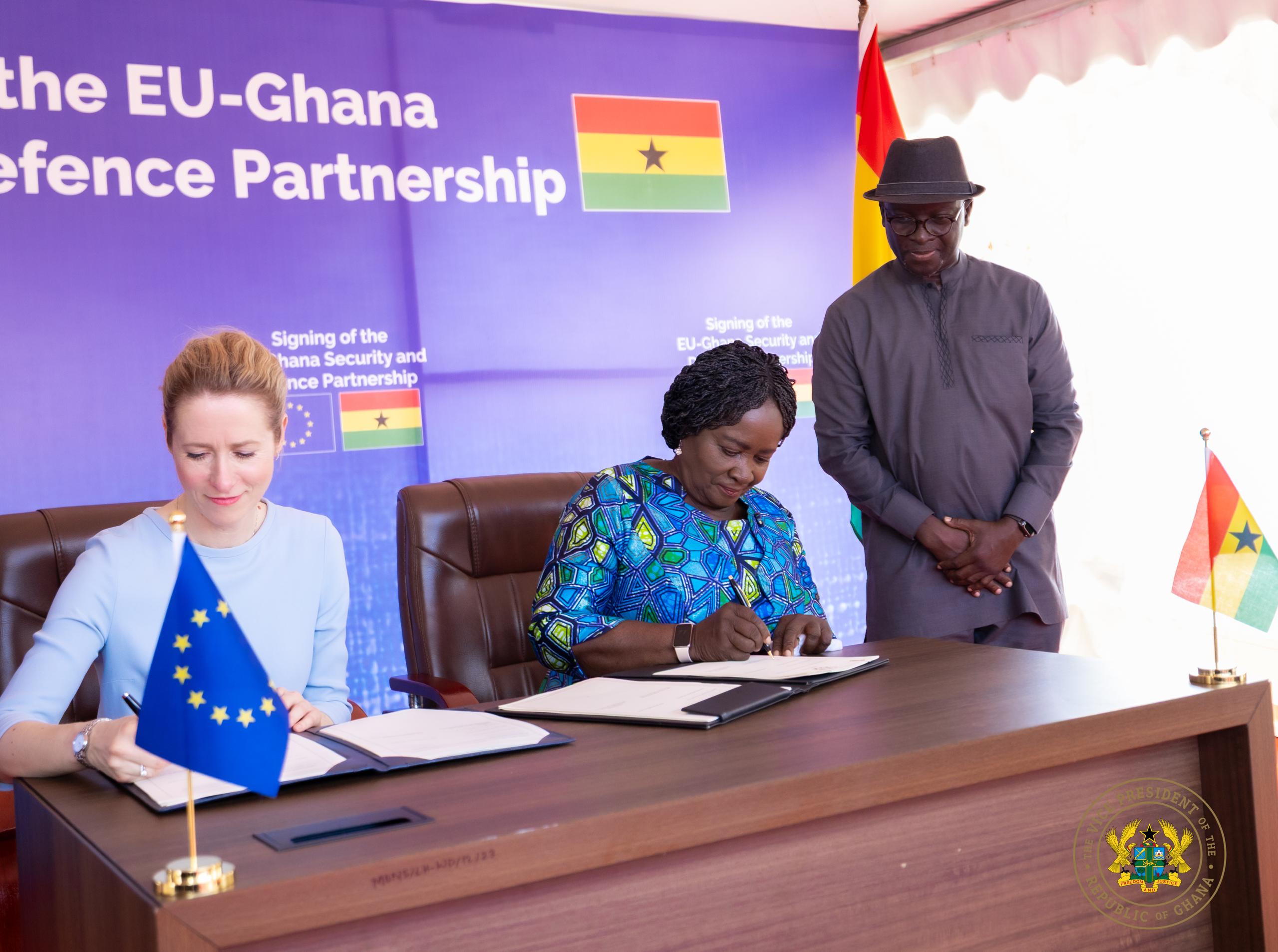

Ghana and the European Union have signed a landmark security and defence partnership, marking the first such agreement between the EU and an African country.
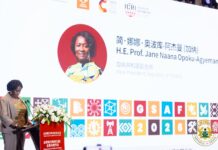
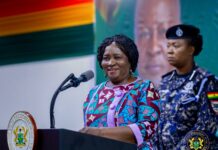
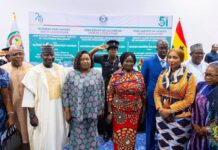
The deal was sealed during a high-level visit by EU Vice President Kaja Kallas, who held talks with Ghana’s Vice President Naana Jane Opoku-Agyemang at the Jubilee House before both delegations moved to the National Security Council Secretariat for further engagements.
Kallas described the agreement as a major milestone, emphasizing its significance in deepening cooperation amid growing global and regional security threats.

“This is the first security and defence partnership we are signing with any African country. It shows how much we value our relationship with Ghana,” she said.
She noted that the partnership will enhance collaboration in key areas such as counterterrorism, cybersecurity, conflict prevention, and border and maritime security. According to her, security in Europe and Africa is “deeply interconnected,” making stronger alliances essential.

Kallas also expressed concern about rising insecurity in West Africa, referencing recent killings in Burkina Faso, and warned against the exploitation of vulnerable Africans in global conflicts.
Vice President Prof. Naana Jane Opoku-Agyemang welcomed the agreement, describing security as the foundation for all aspects of development.
“Without peace and security, we cannot talk about economic relationships, human relations or cultural exchange,” she stated.

She highlighted Ghana’s long-standing relationship with the European Union and said the new agreement will further strengthen ties while providing a structured framework for cooperation in crisis response, peace operations, and capacity building.
At the National Security Council Secretariat, the National Security Coordinator underscored the importance of sustained partnerships in addressing complex and evolving threats. He noted that EU support over the year including training programmes and equipment donations has significantly enhanced the capabilities of Ghana’s security and intelligence agencies.

The partnership also comes with additional support from the EU, including the provision of security equipment such as vehicles, communication systems, drones, and motorcycles to improve operational readiness.
Officials disclosed that more than 30 EU-backed security projects are currently underway in Ghana, covering areas such as counterterrorism, border management, maritime security, and cybersecurity. In addition, dozens of training programmes have been conducted for military and civilian personnel.
The agreement builds on previous collaborations under EU initiatives such as the European Peace Facility and reflects a shared commitment to addressing the root causes of insecurity, including poverty, marginalization, and youth unemployment.
Both Ghana and the European Union expressed optimism that the new partnership will deepen cooperation and contribute to peace and stability in Ghana and the wider West African region.
By Evelyn Tengmaa