
Minister of Health, Kwabena Mintah Akando has reaffirmed the country’s commitment to public–private partnerships (PPPs) as a central pillar of its universal health coverage (UHC) agenda.
He emphasized that innovative collaborations such as Pfizer’s Accord for a Healthier World are already transforming access to essential medicines.
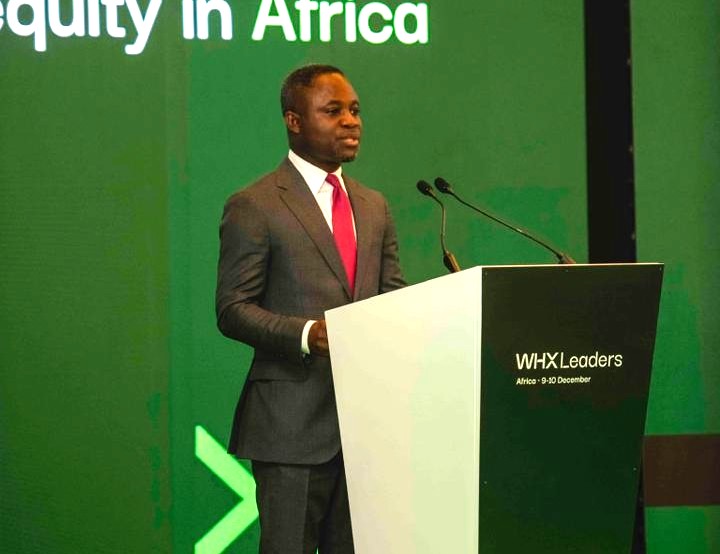
Speaking on the sidelines of the WHX Leaders Conference in Accra, the Minister said Ghana views PPPs not as supplementary arrangements but as “the most sensible pathway for sustainably financing health.”
He explained that the Accord, which Ghana joined in 2022, has proven to be a model worth scaling due to the quality, affordability, and reliability of the medicines provided under its no-profit structure.

According to him, the programme has already delivered significant gains across the country’s major teaching hospitals. “It guarantees the quality of the product, secures affordability, and improves accessibility. These are very good characteristics for ensuring essential medicines reach the people who need them,” he said.
Centralized procurement improving efficiency
Although Ghana’s health procurement system is largely decentralized, the Accord requires centralized negotiation and oversight to achieve uniform pricing and reliable supply.
The Minister noted that this deliberate approach has eased operational bottlenecks and ensured all seven public teaching hospitals benefit from standardized costs and product availability.
He disclosed that several private hospitals have officially requested to join the scheme. The Ministry has initiated the approval process, but he stressed that all facilities—public or private—must operate through the government’s centralized platform to maintain transparency and efficiency.
Unique focus on capacity building beyond clinicians
A notable strength of the Accord, he said, is its investment in capacity building across a wider range of health professionals. Unlike traditional programmes that focus mostly on clinicians, the Accord enhances skills among procurement and supply chain officers, strengthening the efficiency and integrity of medicine distribution systems.
“This is something we must commend,” he noted. “It is refreshing to see capacity building extend beyond doctors and nurses to the staff who keep our supply chains functioning.”

Pricing gap limits expansion beyond teaching hospitals
Despite the programme’s achievements, the Minister acknowledged a major hurdle: the price difference between Accord medicines and lower-cost generics covered by the National Health Insurance Scheme (NHIS) and the newly launched MaHA Market.
With NHIS reimbursements typically aligned to generic prices, teaching hospitals remain the most financially feasible starting point. Expanding to regional hospitals—currently 10, with a push to increase to 16—remains difficult unless pricing harmonization is achieved.
“We are finding it challenging to roll it out to the regional hospitals because the reimbursement price of the NHIS does not correspond to the cost of the Accord product,” he explained. “If we can address this gap, it becomes a good foundation to cover all 16 regions.”
Targeting NCDs and national priority diseases
Ghana has deliberately selected 21 medicines under the Accord, aligning them with the country’s priority health needs—particularly noncommunicable diseases (NCDs), where mortality rates remain high.
The Minister said this approach is consistent with government policy and the Mahama Care agenda, emphasizing that such partnerships help accelerate progress toward the Sustainable Development Goals (SDGs).
“When we choose packages under the Accord, we know exactly what we are doing. We select what will help reduce NCD mortality and advance our SDG commitments,” he said.
Looking ahead
The Minister concluded by urging continued dialogue among governments, partners, and industry stakeholders, expressing optimism that Ghana could scale the Accord nationwide once pricing challenges are resolved. Expanding access, he noted, will require collective effort, but the early results demonstrate the value of well-structured public–private partnerships.
“As we continue this engagement, the potential to strengthen our health system and expand equitable access to medicines is clear,” he said.