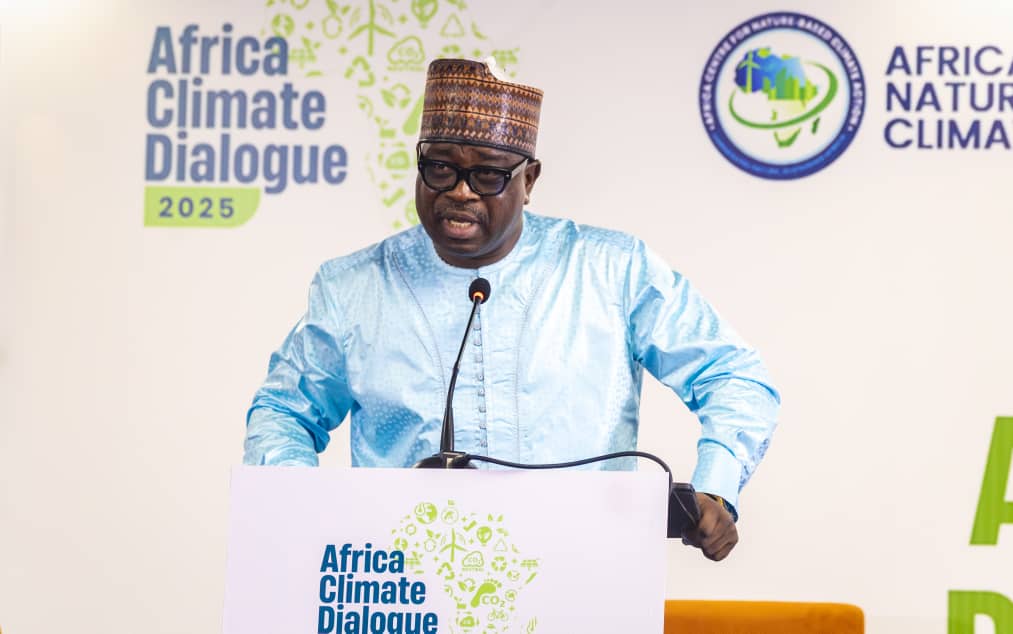

The Government of Ghana is taking steps toward strengthening its climate governance framework with the establishment of a National Climate Change and Sustainability Hub, an initiative designed to drive innovation, research, and collaboration across sectors to accelerate national climate action.
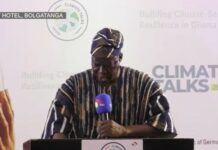
The announcement was made by the Minister of State for Climate Change and Sustainability, Issifu Seidu, during the Africa Climate Dialogue held in Accra.
The event brought together policymakers, climate experts, civil society organizations, and private sector stakeholders to deliberate on how Africa can harness Nature-Based Solutions (NbS) to achieve sustainable development and climate resilience.
Seidu described the proposed Hub as a “centre of excellence dedicated to driving policy innovation, capacity building, and knowledge exchange.”
According to him, the facility will serve as a national platform connecting science, policy, and practice, ensuring that Ghana’s climate strategies are evidence-based and result-oriented.
“The Hub will bridge the gap between research and implementation, ensuring that data, policy, and investments work together to deliver sustainable and inclusive results,” Seidu said.
“We envision a future where climate action is coordinated, innovative, and measurable a future that places sustainability at the heart of national development.”

As part of broader reforms to embed climate consciousness in national governance, the Minister announced plans to institutionalize Climate Change and Sustainability Units across all Ministries, Departments, Agencies, and local government structures.
“By embedding climate leadership across public institutions, we foster a whole-of-government approach that delivers coherent and accountable outcomes,” Seidu explained.
“Every sector from agriculture and transport to finance and health must play its part in building a green, resilient Ghana.”
The initiative, when operationalized, is expected to enhance policy coordination, streamline climate finance, and strengthen Ghana’s capacity to meet its commitments under the Paris Agreement and the Sustainable Development Goals (SDGs).
In her opening remarks, Rev. Dr. Joyce R. Aryee, Board Chair of the Africa Centre for Nature-Based Climate Action (AC4NCA), applauded the government’s commitment and called for deeper public-private partnerships to accelerate nature-based solutions across the continent.
“Nature-based solutions remain the most cost-effective and practical pathway to environmental protection, social inclusion, and economic progress,” Rev. Aryee emphasized.
“By valuing and investing in nature, we secure not only our environment but also our future prosperity.”
She urged African nations to integrate natural capital into economic planning and to prioritize community-driven climate initiatives that deliver both ecological and livelihood benefits.
The Chief Executive of the Forestry Commission, Dr. Hugh Brown, also addressed participants, stressing that illegal mining (“galamsey”) and unsustainable logging remain the biggest threats to Ghana’s forest reserves.
He underscored the importance of sustainable financing and multi-sector collaboration to scale up Nature-Based Solutions, urging government and stakeholders to explore innovative mechanisms such as Payment for Ecosystem Services (PES) and carbon market participation to sustain conservation efforts.
“The deployment of Nature-Based Solutions is a vital pathway to achieving Ghana’s sustainable development goals,” Dr. Brown said.
“We must act collectively to protect our forests and ecosystems the lungs of our nation if we are to sustain progress toward a green and resilient future.”
The Africa Climate Dialogue, hosted by AC4NCA under the theme “Harnessing Nature-Based Solutions: A Pathway to Sustainable National Development,” provided a platform for stakeholders to exchange ideas on integrating ecosystem-based approaches into national and regional climate strategies.
Participants included representatives from government ministries, diplomatic missions, academia, environmental NGOs, and private sector institutions working in climate finance, renewable energy, and sustainable land management.
Discussions focused on scaling climate-smart investments, promoting green jobs, and leveraging innovation for community-based adaptation.
With the announcement of the National Climate Change and Sustainability Hub, Ghana reaffirms its position as one of Africa’s leading voices in climate leadership and green transformation.
The Hub is expected to serve as a continental reference point for climate policy, research, and innovation, fostering collaboration between local and international partners.
As global temperatures continue to rise, Ghana’s proactive measures signal a growing recognition that climate resilience and sustainable growth must go hand in hand.
“This Hub is not just an institution it is a national commitment,” Seidu concluded. “A commitment to sustainability, to innovation, and to the shared responsibility of safeguarding the planet for generations to come.”