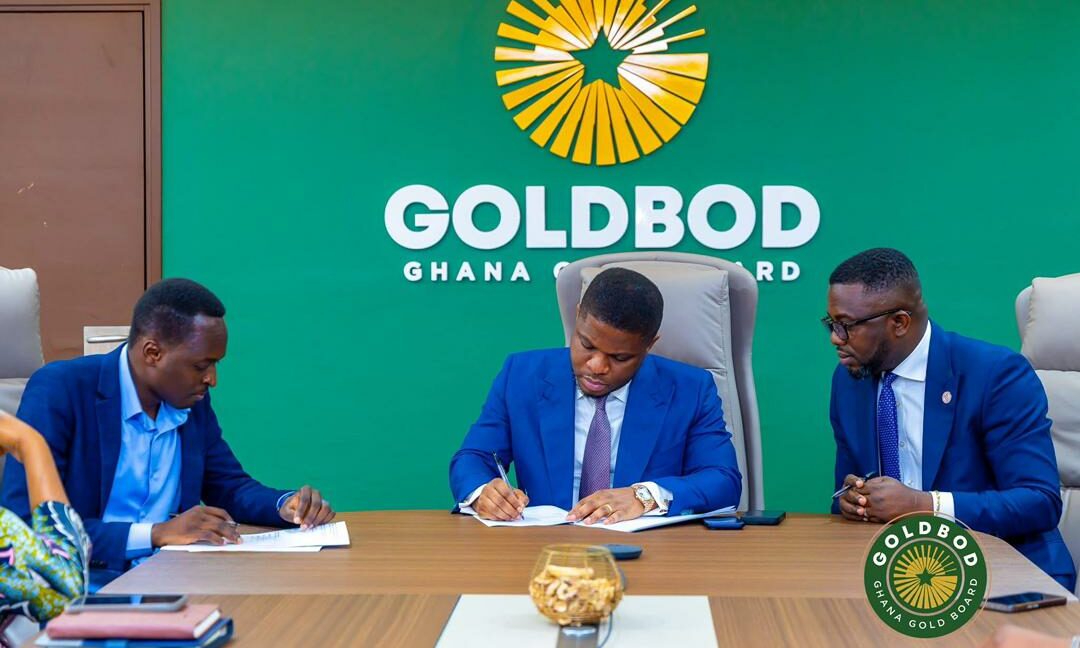

The Ghana Gold Board (GoldBod) has signed a landmark agreement with the Forestry Commission and the Ghana Armed Forces to begin the reclamation and restoration of portions of the heavily degraded Tano Nimiri Forest Reserve, committing approximately GH¢35 million to the project.
Speaking at a signing ceremony in Accra, on Tuesday June 16, 2026, Chief Executive Officer of the Ghana Gold Board, Sammy Gyamfi, described the initiative as the first major reclamation project to be undertaken by the newly established institution under its National Reclamation and Environmental Restoration Programme.
According to him, the Tano Nimiri Forest Reserve was selected following visits by officials from the Gold Board, the Forestry Commission and the Ministry of Lands and Natural Resources, which revealed extensive environmental destruction caused by illegal mining activities.
“We were taken aback by what we saw at Tano Nimiri. The rich vegetation that once existed had been completely destroyed by illegal mining activities. It is for this reason that we decided that this should be the first project funded under our national reclamation programme,” Mr. Gyamfi said.
He clarified that the degradation occurred before the establishment of the Gold Board but stressed that the institution considered it a national responsibility to support efforts to restore the reserve.
Under the agreement, the Ghana Armed Forces’ Engineers Regiment will undertake the civil engineering component of the project, including pit filling, grading, land reshaping, compaction and site stabilization works on 50 hectares of degraded land within Compartment 161 of the forest reserve. The works are expected to commence on July 6, 2026.
Mr. Gyamfi disclosed that the Gold Board will pay GH¢27.9 million to the Engineers Regiment for the earthworks component, while the Forestry Commission will oversee the afforestation and revegetation phase at an estimated cost of GH¢7.2 million over a 10-year period. About GH¢2.2 million is expected to be spent during the first phase of the afforestation programme.
He explained that the decision to engage the Ghana Armed Forces was intended to ensure transparency and integrity in the reclamation process.
“Many people have used reclamation contracts as a cover for illegal mining activities. We wanted a partner that embodies discipline, integrity and patriotism, and we found no better institution than the Ghana Armed Forces,” he stated.
Deputy Minister for Defence, Brogya Genfi, welcomed the partnership and assured the public that the military would execute the project professionally.
“We believe that fighting illegal mining requires both preventive and restorative measures. While prevention stops further destruction, restoration addresses the damage that has already been done. The Ghana Armed Forces will bring professionalism and integrity to this assignment,” he said.
The Chief Executive Officer of the Forestry Commission, Dr. Hugh Brown, also praised the Gold Board for being the first institution to respond positively to the Commission’s appeal for support in reclaiming degraded forest reserves.
He revealed that a survey conducted up to the end of 2024 identified nearly 8,700 hectares of forest reserves degraded by illegal mining activities, equivalent to more than 10,000 football fields. He added that assessments of destruction recorded in 2025 were ongoing and would likely increase the figure.
The Forestry Commission CEO expressed confidence that the collaboration between the Gold Board, the military and other state institutions would provide a sustainable model for restoring degraded landscapes across the country.
A video shown during the ceremony highlighted the extent of devastation within the Tano Nimiri Forest Reserve, including severe damage to vegetation and pollution of the Tano River, a major source of water for several communities.
Officials described the project as a pilot initiative that could be replicated in other degraded forest reserves nationwide if successfully implemented.
By Evelyn Tengmaa