

The Chairman of the National Development Planning Commission (NDPC), Dr. Nii Moi Thompson, has drawn attention to a persistent structural misalignment between Ghana’s national development planning architecture and its budgeting processes, warning that the disconnect is undermining coherent spatial and sectoral development.
His concern reflects a longstanding institutional challenge within the country’s planning ecosystem, where national policy frameworks often articulated through medium to long-term development plans are not consistently synchronized with annual budgetary allocations.
This gap, he notes, weakens implementation fidelity and contributes to fragmented development outcomes across sectors such as agriculture, industry, housing, and infrastructure.
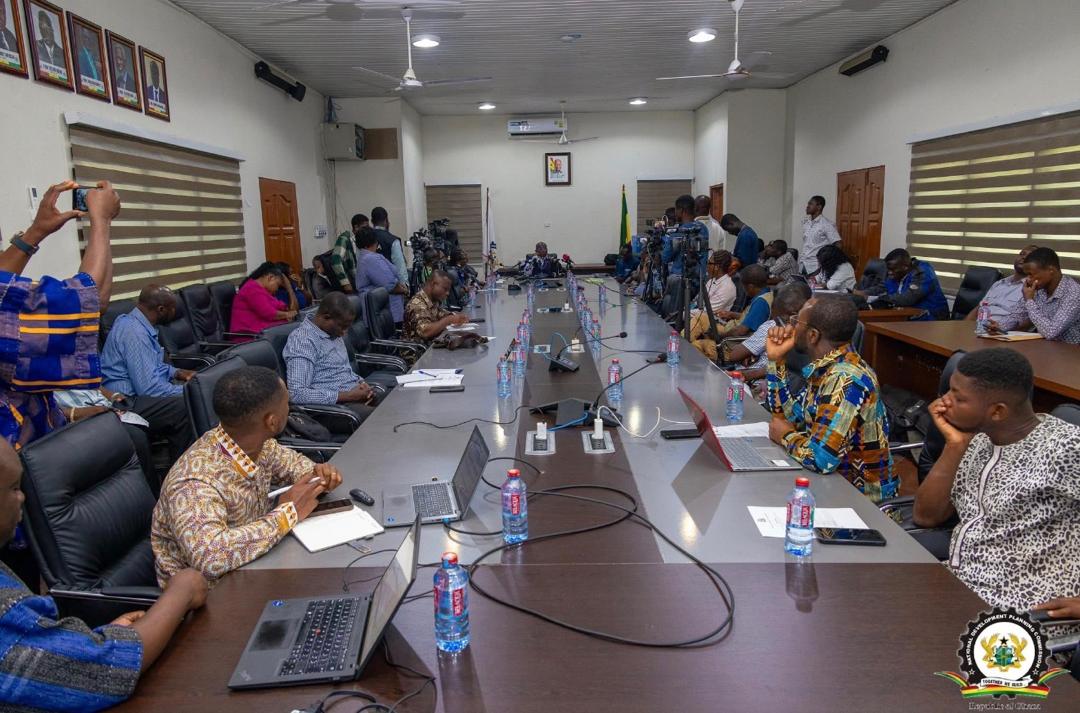
At a media briefing on NDPC’s Strategic Regional Engagements in the Western Region on April 30, Dr. Thompson indicated that the consequences of this misalignment are increasingly visible in the country’s spatial landscape.
Unregulated land-use practices, he explained, are contributing to a pattern of disorder that complicates the execution of planned development schemes. In particular, he cited the proliferation of informal car sales points in urban and peri-urban areas as an example of how uncoordinated land use can distort spatial planning objectives.
According to him, the conversion of open or designated lands into commercial car lots often without adherence to planning regulations has implications for environmental management.
“The paving over of permeable surfaces reduces natural water absorption capacity, a practice that links to heightened flood risks, especially in densely built environments.”
“When spatial planning controls are weak or inconsistently enforced, incremental encroachments can evolve into entrenched patterns that are difficult to reverse. In such contexts, public authorities are often compelled to undertake costly remedial interventions, including resettlement, demolition exercises, and emergency responses to environmental hazards. These unplanned expenditures can place additional strain on public finances and potentially divert resources from priority sectors such as education, health, and industrial development.”
Dr. Thompson further noted that unchecked deviations from spatial plans risk normalizing non-compliance, thereby complicating regulatory enforcement over time. The cumulative effect, he suggested, is a gradual weakening of planning institutions and a reduced capacity to guide orderly development.
As part of proposed remedial measures, the NDPC Chairman advocated for the designation of specific zones for automobile trading within Metropolitan, Municipal, and District Assemblies (MMDAs). The zoning approach, widely used in urban planning systems, is intended to cluster similar economic activities in defined areas, thereby improving land-use efficiency, enhancing regulatory oversight, and mitigating environmental impacts.
The NDPC’s engagement with the Land Use and Spatial Planning Authority (LUSPA), as disclosed by Dr. Thompson, forms part of a broader institutional effort to strengthen coordination between national planning objectives and local spatial implementation. LUSPA, mandated to oversee spatial planning standards and practices, plays a central role in translating policy into enforceable land-use frameworks at the sub-national level.
Within Ghana’s governance structure, the NDPC is tasked with advising the President on development planning policy and coordinating the preparation of national development frameworks.
Eric SdIts current effort to consolidate multiple planning documents into a unified national framework aligns with attempts to reduce fragmentation and improve policy coherence. Such consolidation is also expected to facilitate stronger linkages between planning, budgeting, and monitoring systems.
The emphasis on integrating spatial planning with sectoral development priorities is consistent with global planning principles, particularly those underpinning the Sustainable Development Goals (SDGs), which call for inclusive, safe, resilient, and sustainable human settlements.
Dr. Thompson underscored that achieving these outcomes requires institutional discipline across planning and implementation agencies. In practical terms, this involves adherence to approved spatial plans, alignment of budgets with strategic priorities, and consistent enforcement of land-use regulations by local authorities.
The NDPC’s regional engagements are expected to provide a platform for aligning stakeholders at both national and sub-national levels, with a focus on ensuring that development planning is not only technically sound but also operationally coherent.
By Eric Yaw Adjei