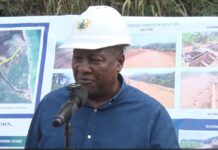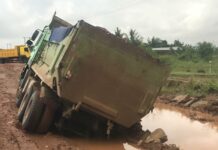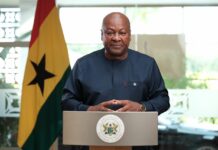

President John Dramani Mahama has signaled his administration’s intention to incorporate the country’s ailing Western Rail Line into the government’s flagship “Big Push” infrastructure programme.
He said this is an intervention that will place renewed focus on a corridor historically central to Ghana’s extractive and agricultural economy.
“We are considering absorbing the Western Rail Line under the big push programme,” the President said at this year’s May Day celebration in Koforidua on May 1.
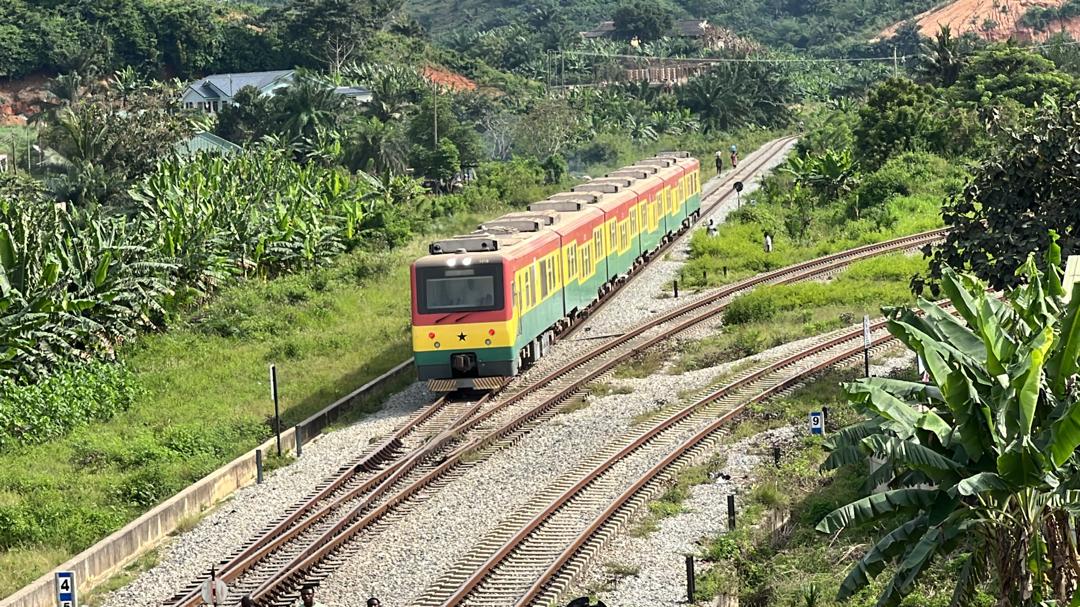
Operated by Ghana Railway Company Limited, the Western Line has, over the past decade, experienced a sustained operational decline.
Once the backbone of bulk haulage between the mineral-rich Western and Western North enclaves and the Takoradi port, the line facilitated the movement of manganese from Nsuta, bauxite from Awaso, timber, cocoa, and other agricultural commodities.
The work of the Western Rail Lines has, however, largely dissipated. Operations have reduced to limited passenger services within the Sekondi–Takoradi enclave, a shift that reflects broader structural challenges within the country’s rail sector.
Rail economics consistently demonstrate that passenger services, particularly over short distances, rarely generate sufficient revenue to sustain rail infrastructure without cross-subsidisation from freight operations. Thus, the absence of consistent bulk cargo haulage particularly manganese and bauxite has eroded the line’s commercial viability.
As a result the Ghana Railway Company Limited has faced persistent financial constraints, with reports of prolonged salary arrears and diminished capacity for maintenance and network expansion. The resulting underinvestment has reinforced a cycle of declining service reliability and reduced patronage from industrial clients.
Recent efforts by the Ministry of Transport Ghana to reintroduce passenger services between Sekondi and Takoradi mark a modest operational revival.
However, within the broader economics of rail transport, such interventions are typically considered transitional rather than transformative. Undoubtedly, the long-term sustainability of the Western Line remains closely tied to the restoration of its freight function particularly along the mineral and agro-industrial belts it historically served.
It is within this context that the proposed inclusion of the Western Line under the Big Push programme assumes strategic significance.
The Big Push, conceived as a large-scale public investment drive targeting critical infrastructure, is designed to unlock productivity across key sectors. For the Western corridor, integration into this framework could provide the capital injection required for track rehabilitation, signalling upgrades, and rolling stock modernisation elements necessary to restore heavy-haul capacity.
President Mahama reiterated the economic rationale underpinning the initiative, noting that completion of the Western Rail Line would “open up the bauxite and manganese corridor” while facilitating the movement of cocoa and other commodities from inland production zones to export terminals.
This aligns with long-standing policy discussions around leveraging rail to reduce pressure on road networks, lower haulage costs, and improve export competitiveness.
Historically, the Western Line’s interface with the Takoradi Harbour positioned it as a critical logistics artery. Manganese exports from Nsuta alone have, over various periods, constituted a significant share of Ghana’s mineral export volumes, with rail providing the most cost-efficient means of transport over long distances. Similarly, bauxite haulage from Awaso has depended on rail connectivity to maintain supply chain efficiency.
The reactivation of this freight ecosystem carries implications beyond the rail sector. A functional Western Line could recalibrate modal distribution in Ghana’s transport mix, shifting heavy cargo away from roads and thereby extending the lifespan of highway infrastructure.
It also has the potential to stimulate ancillary economic activity along the corridor, including warehousing, processing, and inland logistics services.
Traditional authorities within the Western Region have underscored this linkage. During a recent event marking the reintroduction of passenger services, Paramount Chief of Essikadu Nana Kobina Nketsia V highlighted the interdependence between rail and road infrastructure, noting that investments in highways achieve greater durability when complemented by an efficient rail system capable of handling bulk freight.
“The Big Push will be meaningless if it is not linked to the Railways,” he trumpeted
By Eric Yaw Adjei