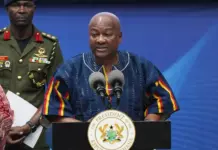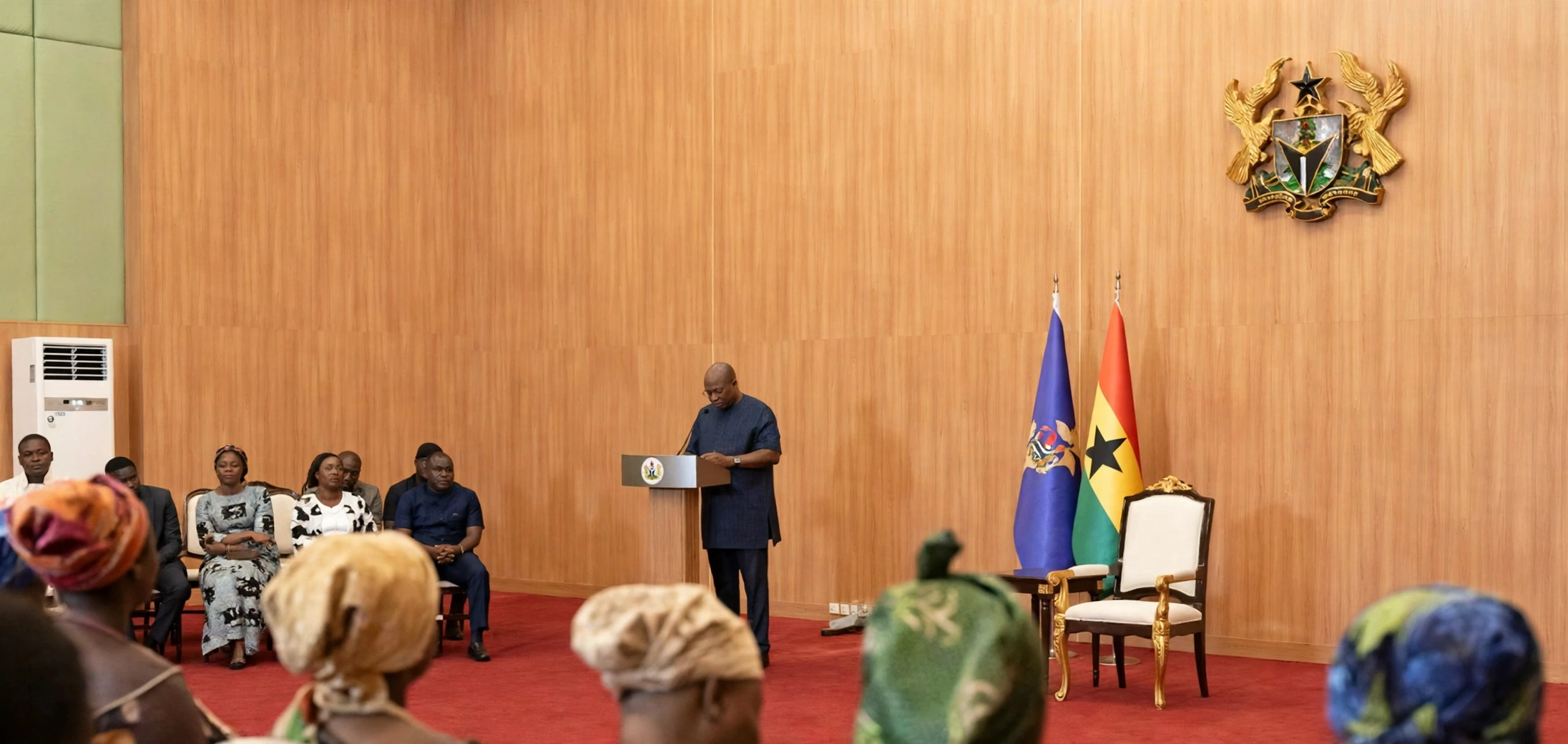

President John Dramani Mahama has appealed to chiefs in the Oti Region to support government efforts to resolve the ethnic and chieftaincy conflicts in the region, particularly in Nkwanta.
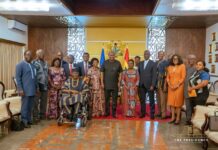
Speaking during a courtesy call by the Oti Regional House of Chiefs at the Jubilee House on November 20, President Mahama said peace was returning to the area but urged the traditional authorities to help sustain it.
“We’ve been having issues with chieftaincy disputes and land disputes, especially in the Nkwanta area. We’ve had to mobilise security forces, soldiers, police and all that, and it’s been a quite difficult situation,” he said.
Chiefs call conflict a national security threat
The appeal followed concerns raised by the President of the Oti Regional House of Chiefs and Paramount Chief of the Likpe Traditional Area, Nana Soglo Alloh IV, who described the recurring conflicts as a serious national security threat requiring urgent government attention.
“The region is currently experiencing serious ethnic and chieftaincy conflicts, and these are of national security concerns. Chieftaincy conflict is therefore a threat to national security, which the government must take seriously, particularly the Nkwanta conflict,” Nana Soglo Alloh IV stated.
Background: The Nkwanta conflict
The Nkwanta conflict is rooted in longstanding disputes over traditional land ownership, territorial authority and chieftaincy, involving the Adele, Challa and Akyode ethnic groups.
It escalated sharply in recent years, claiming dozens of lives, displacing residents and disrupting farming, trade and schooling.
A day before the meeting, the Ministry of the Interior lifted the curfew imposed on parts of the Nkwanta South Municipality following an improvement in the security situation.
The curfew, first imposed on June 19, 2026 after an attack on Odomi in which three people were killed and nine others sustained gunshot wounds, had restricted movement between 8:00 p.m. and 5:00 a.m. in communities including Keri, Abrewanko, Abrewanko Junction, Nyambo, Shari, Kromase, Power, Nyakoma, Odomi, Bonakye and Nkwanta.
The ban on the possession of arms, ammunition and other offensive weapons in the municipality remains in force.
Dambai Bridge finally taking shape
President Mahama also pointed to progress on the long-promised Dambai Bridge over the River Oti as evidence that government was delivering on its commitments to the region.
“The Dambai Bridge discussion, when I became Vice President and became President, it never came to reality. Fortunately, today we all can see that work is going on on the bridge,” he said.
The bridge, about 1.49 kilometres long with approximately 6.8 kilometres of approach roads, is expected to connect Dambai to Kete Krachi and end decades of reliance on ferry services.
It forms part of government’s broader infrastructure drive to improve connectivity along the Eastern Corridor. The Minister for Roads and Highways, Kwame Governs Agbodza, recently said the project was about 10 per cent complete, with approach roads expected to be completed by January 2027.
Eastern Corridor roads back on track
On roads, President Mahama said his government had returned to complete the Eastern Corridor, which he said was abandoned for eight years after he left office.
“We are working on quite a number of the roads. The Eastern Corridor was started in Posa, Tamilstan. It continued in my time. After we left, it was abandoned for eight years. As you can see, we’ve come back and we are tackling it again,” he said.
“We have three segments from the south, that is from Essikuma Junction through Have to Hohoe, and then from Hohoe to Jasikan, and then the two sides near Nkwanta all the way to Pasa and to Damongo.”
The Eastern Corridor, the N2 highway, runs from Tema through Asikuma, Hohoe, Jasikan, Nkwanta and on to Kulungugu on the Burkina Faso border, serving as the main north-south route in eastern Ghana.
The Roads Minister has said the outstanding sections from Esikuma Junction through Peki, Have, Golokwati, Hohoe, Jasikan, Dodi Pepeso, Kpassa and Oti-Domanko are targeted for completion by December 2027.