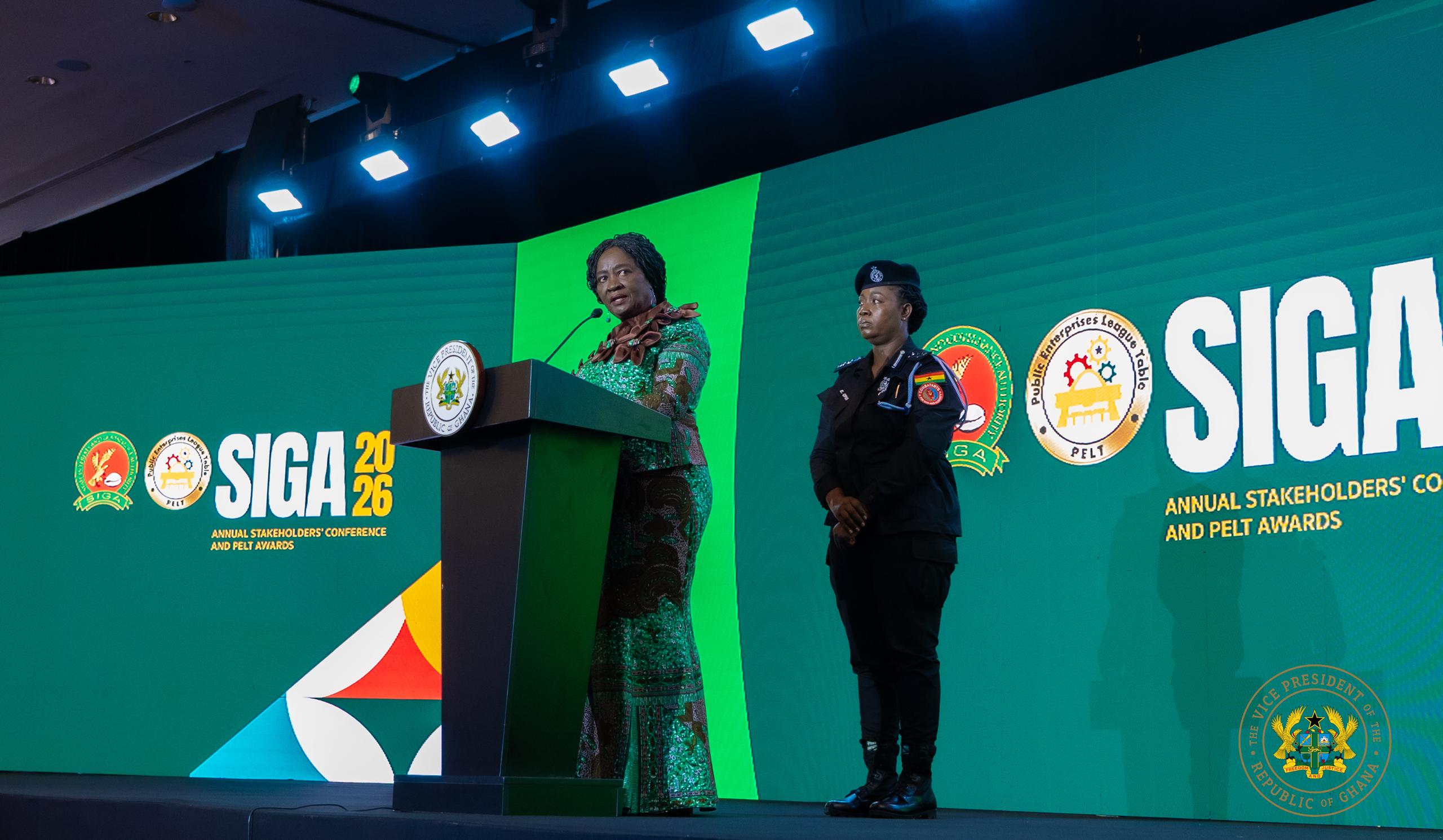

The Vice President Professor Naana Jane Opoku-Agyemang has called for sweeping reforms to transform Ghana’s state-owned enterprises into efficient, profitable, and accountable institutions that deliver real value to citizens.
Speaking at the 2026 Annual Conference of the State Interests and Governance Authority (SIGA) in Accra on March 19, she described public enterprises as critical national assets and key drivers of economic transformation.
“Our public enterprises are instruments of transformation and engines of national development,” she stated, emphasizing the need for a renewed focus on growth, accountability, and sustainability.
The Vice President noted that over 170 specified entities operate across key sectors of the economy, managing significant assets and employing thousands of Ghanaians. While these institutions generate billions in revenue, she acknowledged that persistent operational losses and rising liabilities continue to put pressure on public finances.
She warned that financial indiscipline must not define the future of the sector, posing a critical question: how can Ghana transform public enterprises from fiscal burdens into engines of shared prosperity?
According to her, the government has made this a key priority since assuming office, with a strong commitment to repositioning state-owned enterprises as value-creating institutions.
She outlined ongoing reforms being implemented in collaboration with the Ministry of Finance and SIGA, aimed at improving governance, strengthening oversight, and ensuring financial sustainability.
A major component of the reform agenda is a comprehensive review of the state’s equity portfolio to assess the financial health and strategic relevance of various enterprises. The review is expected to guide decisions on restructuring underperforming entities, while profitable ones may see increased government investment or potential listing on the stock exchange.
The Vice President also announced plans to expand performance contracts across all state institutions, enhance board accountability, and introduce performance-based remuneration systems.
“These measures are about resetting standards across the system,” she said, stressing the need for transparency, discipline, and adherence to best practices.
She further highlighted the introduction of a public enterprise performance ranking system aimed at improving transparency and encouraging competition among institutions.
Drawing comparisons with reform efforts in South Africa, Kenya, and Morocco, she noted that strong governance is essential for improved performance and national prosperity.
The Vice President reaffirmed government’s commitment to building a performance-driven public sector, supported by strategic partnerships with the private sector to boost investment and innovation.
She said the success of public enterprises is central to Ghana’s overall development.
“If they succeed, then government succeeds,” she said.
By Evelyn Tengmaa