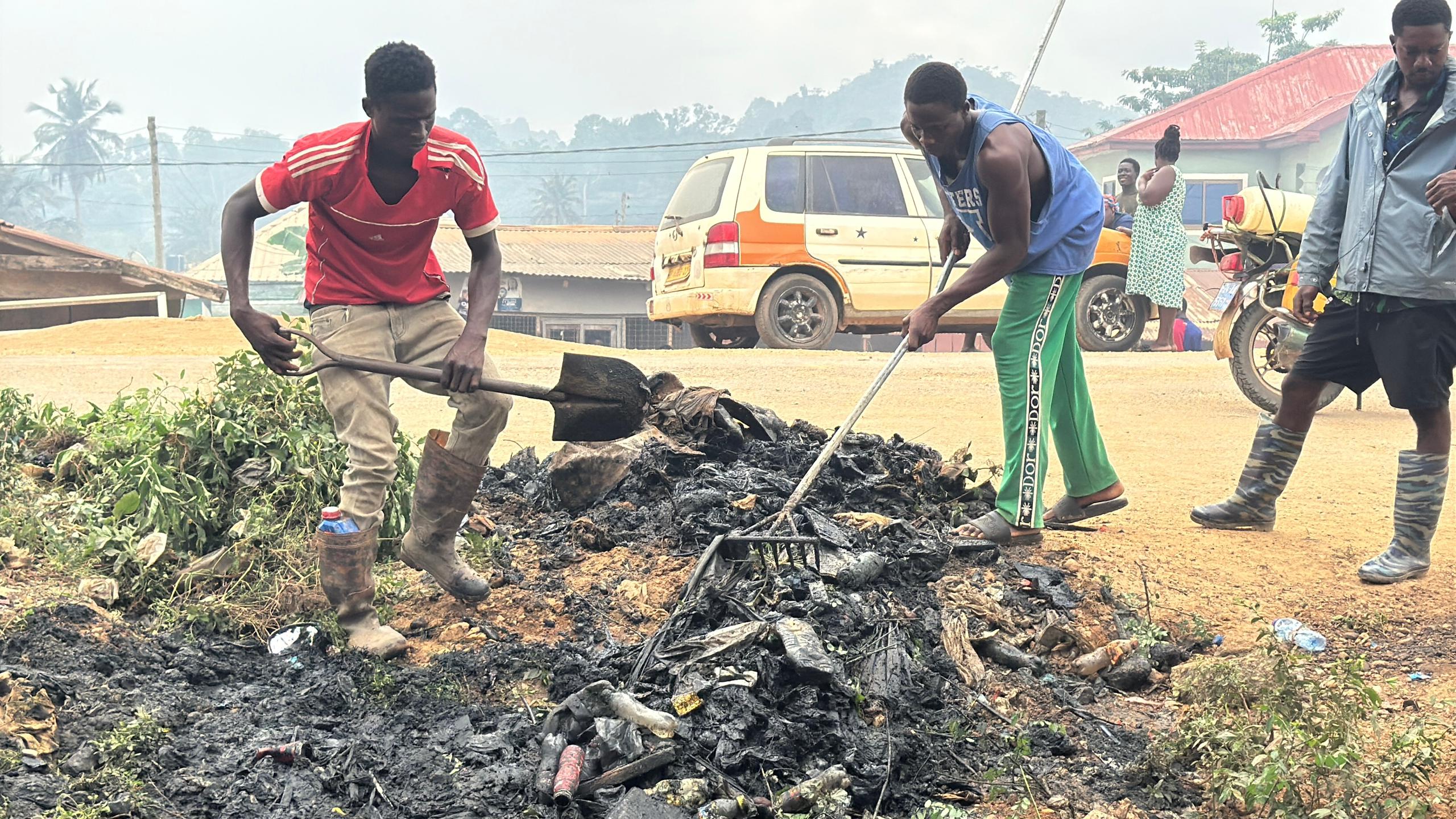

In support of the President John Dramani Mahama’s National Sanitation Day relaunch, Prestea residents in the Prestea Huni Valley Municipality on Wednesday September 10, came together for a massive community cleanup, backing the Assembly’s initiative.
Chief of Prestea Himan, Nana Ntaboah Prah commended the residents’ enthusiasm, urging them to sustain their efforts and emphasizing the importance of community-driven initiatives for lasting impact.
Meanwhile, Member of Parliament Robert Wisdom Cudjoe encouraged constituents to uphold good sanitation practices, avoid indiscriminate dumping, and participate in future cleanup exercises.

On most Wednesday mornings in Prestea, the hum of generators and distant mining activity dominate the soundscape.
But on this particular Wednesday, a different rhythm filled the air, the scrape of rakes, the rustle of brooms, and the purposeful chatter of hundreds of volunteers.
Led by Municipal Chief Executive Matthew Ayeh, who rolled up his sleeves in a simple T-shirt, reflector vest, and boots, wielding a long broom alongside volunteers, the scene embodied determination and community spirit.

This wasn’t a photo opportunity it was the frontline of a quiet revolution in urban management
Mathew Ayeh is the Prestea Huni Valley municipal chief executive , he said “The process has been a success, and I’m thoroughly impressed with today’s high turnout. As a result, I’ve instructed the urban council to institutionalize this initiative, making it a regular practice rather than an annual event, to ensure its sustainability.”

He explained their choice of Wednesday for National Sanitation Day instead of Saturdays.
“Our municipality is predominantly a mining area, and Fridays are busy days for the Prestea market, while Saturdays are busy for the Bogoso market.
Additionally, about 70% of the residents in Prestea are Muslims, for whom Fridays are a significant day. Considering these factors, scheduling activities on Fridays or Saturdays would be challenging. Therefore, we chose Wednesday as it provides a better opportunity for community participation, being a relatively quieter day for the majority.”

For years, the Prestea-Huni Valley Municipality, rich in gold and history, struggled with the consequences of rapid growth: unplanned development, overwhelming waste, and clogged drainage systems that turned every rainfall into a torrent of plastic and sewage.
The problem seemed insurmountable, but Matthew Ayeh, with his analytical background, took a different approach.
He prescribed a simple yet powerful solution: a monthly mass cleanup exercise, mandatory for assembly staff and enthusiastically encouraged for all citizens.
This initiative is more than just a cleanup effort; it’s a visible manifestation of a broader urban planning strategy.
Member of Parliament Robert Wisdom Cudjoe advised constituents to refrain from indiscriminate refuse dumping and encouraged them to actively participate in clean-up exercises.
“Today, we’ve completed our cleanup exercise, and we hope not to have to return next month. We’re pleading with community members to ensure that refuse is disposed of properly at designated sites, so we don’t have to see the same issues again.
Overall, the exercise has been very successful, and I’m impressed with the high turnout and the level of commitment shown by the youth. My hope is that we can sustain this momentum.” He stated.

For the youth, the cleanup exercise has ignited a sense of civic pride. Emmanuel Konzy, a local gold buying and refinery operator, mobilized a group of friends to participate, exemplifying the community’s growing passion for the initiative.
“This initiative will help eradicate malaria and cholera outbreaks in our communities. I urge all my fellow youths to join hands in such activities to maintain a cleaner environment.
I’m happy to participate and look forward to continued community efforts.” He said.
As the morning sun climbed higher, the collective effort bore fruit: a substantial pile of trash, including plastic bottles, discarded sachets, and old packaging, stood as a testament to the community’s hard work.
The air, once heavy with the stench of decay, began to clear.
The Chief of Prestea Himan, Nana Ntaboah Prah, commended the residents for their enthusiasm and initiative, urging them to continue taking ownership of their community’s cleanliness without waiting for external prompts.
“I congratulate the youths, parents, and everyone who participated in this cleanup exercise.
I believe we shouldn’t wait for directives from the President, ministers, or our municipal chief executive to take action.
Instead, every community should regularly organize its own sanitation efforts to keep our environment clean, beautiful, and disease-free.
Let’s take ownership of our communities and work together to prevent diseases and promote a healthy environment.”
As the truck, laden with the tangible results of their labor, drove away, it left behind more than just cleaner streets.
It left a renewed sense of possibility. While the gold beneath the earth built Prestea’s past, a different treasure was being unearthed on the surface the value of collective effort and the transformative power of a leader who leads by example, shovel in hand.