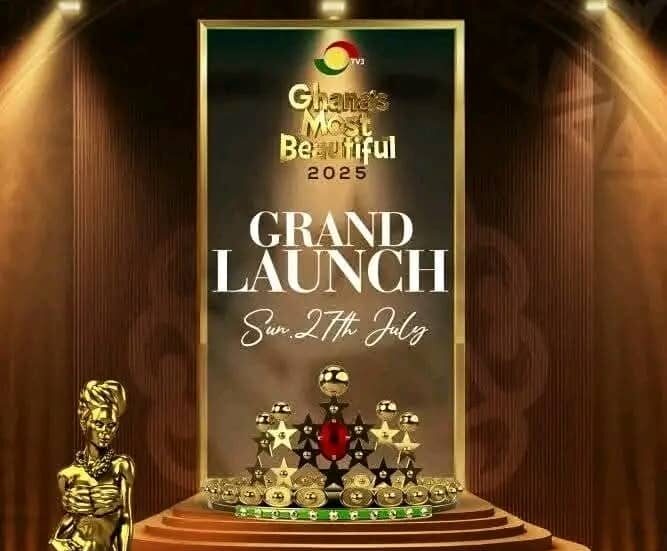

Whoever at Adesa We Productions Ltd. first whispered the idea to launch this year’s Ghana’s Most Beautiful (GMB) pageant and the 19th edition at the Black Star Square deserves a standing ovation and perhaps, a weekend in Akosombo on the company’s bill.
Because what unfolded on the evening of Sunday, July 27, 2025, wasn’t just a launch, it was a national moment. A marriage of culture and symbolism. A reminder that GMB is not just a show. It’s a movement. A platform. A mirror.
And where better to reflect the soul of a nation than at Independence Square, the very heartbeat of Ghana’s republican identity? As the sun lazily dipped behind the Gulf of Guinea, 16 beautifully dressed young women — queens in every sense-sat in royal formation under the towering Black Star Monument, clothed in colours that spoke the languages of their people.
Their gowns, expertly crafted from GTP textiles, told stories, not just of glamour, but of tradition, identity, and resilience. Each sat on a traditional stool from her region — the Asipim, the Mpɔnsɔ, the Wɔmɔ yeli, the Dagaare bɔlga, the Dzidzɔ seat, and as the drone camera floated above, it wasn’t just a shot for the archives. It was a statement. We were Embracing Cultural Diversity to Promote National Unity.”
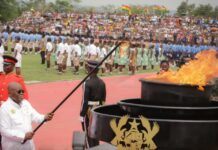
Why Black Star Square? Because that ground has felt the footsteps of giants. That arch has heard the cry of independence and seen the tears of liberation. Presidents have saluted from that dais. Schoolchildren have paraded there in March. Soldiers have stood still there, in the name of the flag.
For GMB to now take its place in that space means something deeper. It told the contestants and the entire nation that this journey they’re on is not just about crowns and catwalks. It’s about nation-building. That they, like the freedom fighters before them, carry the hopes of millions. To sit under that arch was to sit under history itself. To absorb its spirit. To feel seen by Nkrumah and all the mothers of our land whose songs still echo through our markets and courtyards.
If you listened closely during the launch, you might have heard snippets of Ghana’s heartbeat. The fontomfrom from Ashanti, the agbadza from Volta, the bawa of the North. Songs of the Kundum, Damba, Akwasidae, Fetu Afahye, Homowo, Kundum, Kɔbena, Kpini, and Yam Festivals blared gently through the speakers.
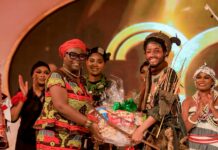
The soundscape was intentional, not just music, but memory. As each contestant was introduced, their story echoed not through words, but through rhythm, colour, and movement—the living language of culture. Etornam, representing the Volta Region, danced in melodious Eʋe rhythm, her feet beating the earth like the Agbadza drums, wrapped in vibrant GTP fabric that shimmered with ancestral pride.
Bubah, hailing from the North East, stepped in regally, her fugu swaying with grace, evoking the spirit of ancestral lands and dreams rising like the northern sun. Busi of Savannah moved with the strength of the Gonja warriors, her posture fierce, her rhythm steady, carrying centuries of bold history in every step.
Boatemaa, proudly representing Ahafo, swirled gently like the leaves of the cocoa trees she embodies, her dance whispering of forests, unity, and community values. In her vibrant display, Yeli of Bono leapt to the playful beats of the Apoo Festival, her expressions singing of laughter, freedom, and truth that dances even when unspoken.
Tasalla, the Northern Region’s representative, spun to the haunting echoes of fire festival drums, her feet steady, her frame upright—a flame of resilience lighting her path. From the heart of the Ashanti Kingdom, Sika was majestic in Kente, her movements a visual hymn from Manhyia to Adum, weaving royalty, reverence, and rhythm into every gesture.
Adwoa, carrying the pride of the Eastern Region, graced the stage like a Dipo maiden, each turn of her body honouring growth, womanhood, and the quiet power of Akuapem wisdom. With movements echoing migration and memory, Nana of Bono East traced the old paths of Akwantukese, each spin a remembrance of roots, identity, and passage.
Diyua, standing for the Oti Region, danced to a fusion of Nchumuru rhythms, a soft force balancing heritage and harmony across a land of many tongues.
The Upper West’s own Naawere glided in sync with the sounds of xylophones and harvest songs, her movements speaking of the Wa Naa, of grain, joy, and perseverance.
Heema, the pride of Western North, shimmered like Bonsu Nkwanta’s gold, her motions unearthing the richness of cocoa, the dignity of toil, and beauty buried deep within her homeland. From the Central Region came Afedziwa, storming the stage like an Asafo warrior, her dance rooted in Fetu Afahye, with poetry stitched into every step she took.
Owubah, glowing with the soul of the Western Region, flowed like the Ahanta waves, her grace carrying tales of resistance, coastal beauty, and history written in sea breeze and sand.
Greater Accra’s vibrant Adjorkor pulsed to the rhythm of urban Ga traditions, her call of “Nɔɔ gbɛ naa!” ringing boldly through the Square, blending heritage with city soul. And Asakia, steadfast from the Upper East, stood tall like the rocks of Tongo, her movement unbending, grounded in Tengmaalug, millet harvests, and resilience carved in stone.
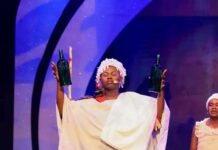
They did not speak with words that day—but through their dance, attire, and the live backing of the National Theatre’s cultural troupe, they narrated the powerful beauty of Ghana. Each twirl, step, and rhythm was a chapter. Each contestant, a living manuscript of her people.
Together, they brought Black Star Square to life, not just with spectacle, but with spirit. The rhythms took us on a journey from the forest belts to the Sahel north, through the lagoons of Keta and the highlands of Kwahu. This was not a mere launch; it was a national cultural display, served on the golden plate of prime-time TV.
And Osagyefo was watching- One could imagine the bronze statue of Kwame Nkrumah, just metres away at his Mausoleum, looking across with pride. These were the daughters of the nation he dreamed of. Educated. Articulate. Poised. Rooted. Rising. Some had studied science. Others were into fashion, communication, advocacy, and agriculture.
It was as though Nkrumah himself had blessed this batch. “Seek ye first the cultural emancipation of your people,” he might have said. And these ladies, it appears, heard him loud and clear. Why GMB Still Matters GMB is not merely a Sunday-night diversion. It’s our cultural archive, being preserved in high definition.
It is perhaps the only show on TV that can get a teenager in Tamale, a grandmother in Elmina, and a taxi driver in Madina all to sit down and shout at the screen. And when the nkontomire is bubbling on the fire and the mortar pounds fufu to the beat of the contestant intros, that is when you know: this is no ordinary program.
Over the years, queens like Naa, Teiya, Emefa, Poka and Titiaka have gone on to launch foundations, educate hundreds, represent Ghana abroad, and challenge societal stereotypes, all from the springboard of this show.
That is why companies line up to advertise. That is why GMB continues to dominate ratings between 8 pm and 10 pm every Sunday on TV3. As Anita Akua Akufo and Cookie Tee would say, “Kɔkɔɔa, kɔkɔɔ, tumtumaa, tumtum, tenten kakra, tietia kakra… they are all beautiful!”
Final Thoughts
Adesa We’s production team deserves all the praise they get, for the symbolism, the staging, the storytelling, and above all, for constantly evolving the show while remaining anchored in cultural truth.
It was more than a launch. It was a pilgrimage to identity. So, if you’re not already tuned in, mark it down: 📺 TV3, Sundays, 8:00 pm – 10:00 pm 🎭 Ghana’s Most Beautiful – Where heritage meets hope.
再见 Zàijià in Mandarin and in Frafra (Gurune), “Yɛɛla” or “Yɛɛla, Naŋŋ”
Let God lead. Let Ghana shine.
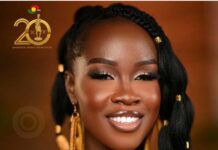
Here are the beautiful queens for this year’s GMB: