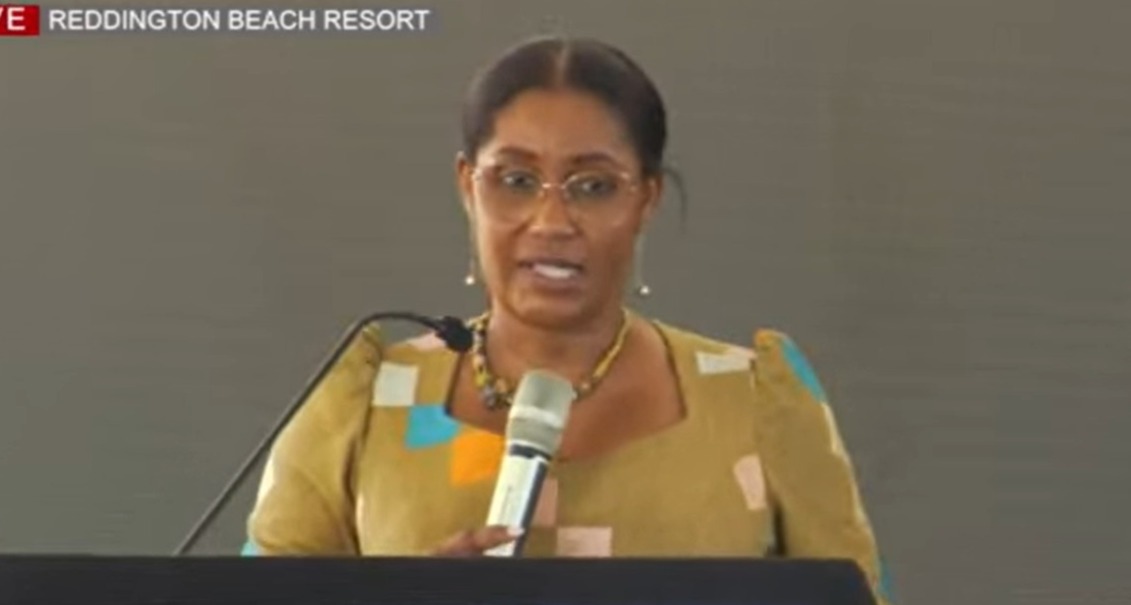

The Chief Executive of the Petroleum Commission, Emeafa Hardcastle has revealed that government has tasked her outfit and the Ghana National Petroleum Corporation (GNPC) to attract needed investments to accelerate exploration efforts in the Voltaiain basin.
She disclosed this at the Volta Economic Forum held at Angloga on October 31.
“The Voltaian Basin is one of four sedimentary basins in Ghana of interest to the upstream oil and gas industry. It is the single largest basin in Ghana, wholly onshore and has huge potential for commercial oil and gas accumulation. Oil and gas shows were recorded in shallow hydrodynamic/stratigraphic wells drilled in the basin in the 1960s.
With an area of about 103,000 sq km it covers about 40% of the land surface of Ghana and nearly twice the size of the explorable area of the offshore sedimentary basins. The basin covers parts of eight regions namely; the Volta, Eastern Region, Oti, Ashanti, Bono East, Savana, Northern and Northeast regions,” she said.
Mrs Hardcastle noted that, “despite this astonishing size of the basin, its petroleum potential remains unknown due to the lack of exploration activities for many decades following the departure of the Soviet Geologists in the 1970s.”
It is for this reason that government wants to attract investors to explore its potentials.
Please read full speech below:
Introduction
I am honoured to be invited to the very first VR Economic Forum, not just in my professional capacity as the Ag. Chief Executive Officer of the Petroleum Commission, but also as a proud daughter of this Land, to share with you the efforts being made by the Government to establish and harness the oil and gas potential of the vast onshore Voltaian Basin.
The Voltaian Basin is one of four sedimentary basins in Ghana of interest to the upstream oil and gas industry. It is the single largest basin in Ghana, wholly onshore and has huge potential for commercial oil and gas accumulation. Oil and gas shows were recorded in shallow hydrodynamic/stratigraphic wells drilled in the basin in the 1960s.
With an area of about 103,000 sq km it covers about 40% of the land surface of Ghana and nearly twice the size of the explorable area of the offshore sedimentary basins. The basin covers parts of eight regions namely; the Volta, Eastern Region, Oti, Ashanti, Bono East, Savana, Northern and Northeast regions.
Togbe, Mr. Chairman, despite this astonishing size of the basin, its petroleum potential remains unknown due to the lack of exploration activities for many decades following the departure of the Soviet Geologists in the 1970s.
The government has taken a policy decision that this must change and has tasked the Petroleum Commission and GNPC to attract needed investments to accelerate exploration efforts in the Voltaiain basin.
Today, I am here to share with you the Basin’s story. A story of the Past, the Present and the Future.
The Past: Exploration History of the Voltaian Basin
The Voltaian Basin has been of interest to oil and gas explorers since the early part of 1900. Initial exploration activities were undertaken by a collaboration between the then Gold Coast Geological Survey (now Ghana Geological Survey Authority) and Soviet Geologists. These early works, which included the drilling of ten (10) boreholes, led to the observation of bituminous substances and natural gas in some of the wells. The observation of these petroleum-like substances gave hope that the Voltaian Basin could be endowed with hydrcarbons.
Mr. Chairman, in 1975, Shell Exploration and Production Company of Ghana acquired 208-line kilometres of 2D seismic data and subsequently drilled the first exploratory well, Premuase-1 in the basin in 1977. Even though the well did not discover petroleum, it provided critical foundational information for future studies including the 2008-2009 aeromagnetic survey conducted jointly by the Geological Survey Department (GSD) and the European Union (EU) under the Mining Sector Support Programme.
THE PRESENT: THE GNPC VOLTAIAN BASIN PROJECT & LICENSE AWARD
Exploration in the Voltaian Basin
Currently, as part of the efforts to accelerate the exploitation of the country’s petroleum resources in all of Ghana’s geological basins, the Ghana National Petroleum Corporation (GNPC) has leapfrogged with exploration efforts in the highly prospective Voltaian Basin. The GNPC has completed the phase 3 of its 2D seismic acquisition programme which commenced in December 2021. This infill campaign acquired an additional One Thousand Six Hundred and Fifty-Five (1655) line kilometre (Km) of 2D seismic lines. The Corporation after the completion and interpretation of the seismic data, plans to drill two exploration well in the basin by Third Quarter, 2026.
The exploration of the Voltaian Basin, once successful, will signify a new dawn of onshore hydrocarbon exploitation/production in Ghana. Extensive consultations and engagements have taken place by the joint efforts of the Petroleum Commission and GNPC with the communities in the catchment area of the Voltaian Basin project to secure a social licence for exploitation.
Ladies and Gentlemen, let me add that besides the exploration activities being undertaken by GNPC three other private E&P companies have been granted licenses to undertake various exploration activities, including the drilling of exploratory wells at different locations within the basin.
Opportunities For Local Development
Onshore oil projects in Ghana in which substantial opportunities lie in the Volta region offer potential benefits such as increased government revenue through taxes and royalties for local development, job creation at the local level, local SME development and enhanced energy security by reducing reliance on imports at the macro level. These projects can also stimulate economic growth by attracting foreign direct investment (FDI) and supporting local infrastructure development and cottage industries through economic linkages. Additionally, the Voltaian basin project, once it matures will be logistically simpler and less exposed to operational challenges of offshore operations and will create significant opportunities for local SMEs.
Challenges with Onshore Petroleum Activities
Togbe Chairman, Ladies & Gentlemen, onshore petroleum activities present unique challenges and we need the collaborative efforts of us all to address them. With your permission, Togbe, let me mention few of them:
- Migration
The Voltaian Basin project typical of other land-based projects will attract migration from the neigbouring communities once it becomes a reality. Experience from Kenya and Uganda, demonstrate that the promise and perceived opportunities of oil and gas discovery are likely to attract in-migration to the region once commercial petroleum activities commence. Whilst not inherently problematic, such a trend will add pressures to a communities dominated by natural-resource intensive livelihoods such as agriculture, forestry, and fishing and may have damaging consequences if measures to curtail same are not put in place. The Petroleum Commission and the Ministry of Energy & Green Transition will at the appropriate time deepen the engagement with the communities that may be affected with the actual development of onshore hydrocarbons in the basin.
- Unequal benefits
Whilst the potential petroleum activities in the region may generate economic benefits for some individuals, the communities whose livelihoods are based on small-scale traditional economic activities, may suffer from these activities and their concerns would need to be addressed.
- Inadequate compensation
Experiences from communities especially in mining where lands were obtained from farmers and cleared for commercial projects have not always been pleasant as some affected communities reportedly receive inadequate compensation for their land, crops and other commercial possessions on those lands, while at the same time the benefits of revenue from those projects were not perceived as offsetting the damage to their livelihoods. Experience suggests that this issue is likely to resurface, and the government is not oblivious to this potential challenge.
Consequently, How Do We Ensure Inclusive Growth?
Acknowledging the various potential challenges evidenced from a host of many contexts from the onset of the Voltaian basin project, the Petroleum Commission is working to support legislative, policy, and administrative reforms to ensure Ghana’s petroleum sector will become a driver of inclusive growth. The Commission’s programme involves working with the relevant government institutions such as GNPC, AG’s department, GRA and other oversight actors to support interventions aimed at developing the effective regulatory framework, revenue capture, management and accountability to ensure that Ghanaians benefit from the petroleum resources.
As part of this process, the government is reviewing the Onshore Policy to promote greater participation (both in governance and productive processes) and promote wider access to the outcomes and benefits to be derived from activities in the basin.
Early engagement such as the one we are having today, both at the policy level with relevant government agencies, traditional rulers and with the communities themselves to understand key local dynamics such as land use patterns, livelihood impacts, and natural resource management strategies, is key to ensuring both the stability of the Voltaian basin regions and delivering on the promise of genuinely inclusive development. Early engagement provides opportunities to build the social license and mitigate against social risk and local impacts, and also enabling stakeholders engaged in petroleum activities to operate in a constructive environment.
The government’s initial steps have begun, and we will liaise with the Chiefs and good people of Volta region in a multi-stakeholder engagement (community, industry, local government) as activities progress. This first event has provided an opportunity to share our thoughts and an approach on future engagement mechanisms, ensuring community concerns are captured and considered.
Conclusion
Togbe, MR. Chairman, there is no doubt that the Voltaian Basin potentially holds the key to Ghana’s oil and gas future. It is therefore imperative to accelerate exploration activities to establish its petroleum potential and the Government is committed to ensuring same. Following the drilling of the exploratory well(s), by GNPC next year, investors will be invited to acquire rights to conduct exploration and production activities in several acreages within the basin.
Togbe Chairman, Distinguished Guests, Ladies and gentlemen, I will end by asking all Ghanaians, especially the good people of Volta region to support the Government in successfully executing its objective of attracting the needed investment into the Voltaian Basin for our collective benefit.
Thank you and May God bless us All.