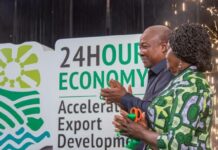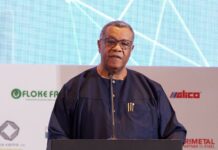

Commissioner of the National Development Planning Commission (NDPC), Dr. Elikplim Kwabla Apetgorgbor has touted the Volta Region as the key anchor to successfully set in motion Ghana’s 24-Hour Economy policy.
Speaking at the maiden Volta Economic Forum on Friday, October 31, 2025, Dr. Apetgorgbor underscored the region’s strategic importance in the roll out of the 24-Hour Economy policy.
“The Volta Corridor is more than a regional development initiative; it is the launchpad for Ghana’s 24-Hour Economy take-off,” he stated.
He said if the region’s geographic advantages, rich resources, and coordinated leadership are harnessed, Ghana is poised to create an economy that never sleeps; one that continuously creates jobs, drives exports, and sustains national prosperity.
He said the region is “corridor of possibility” — a place where trade, logistics, agro-processing, manufacturing, and tourism can operate seamlessly around the clock to drive inclusive economic growth.
Explaining why the region is crucial for the policy, he noted that the Volta Corridor possess unique advantages that make it essential to Ghana’s long-term industrial and economic diversification plan.
The region’s direct access to the Eastern Corridor road, the Lake Volta transport, and the Aflao border post, he said serves as a natural logistics hub connecting Ghana to the wider ECOWAS market.
“The region’s strong local resource base — from cocoa, cassava, and aquaculture to salt mining, tourism, and light manufacturing — provides a foundation for a 24-hour economic model that extends productivity beyond daylight,” he stated.
He added: “this ecosystem is reinforced by national policy alignment through the Ghana Investment Promotion Centre (GIPC), the Ministry of Food and Agriculture (MoFA), and the Volta Regional Coordinating Council (VRCC).”
Investment Pillars for a 24-Hour Economy
According to Dr. Apetgorgbor, five investment pillars were identified as engines of continuous economic activity at the forum.
1. Agro-Processing and Food Systems: Districts such as Adaklu, Central Tongu, Akatsi North and South, and Ketu North have the capacity to sustain processing, warehousing, and logistics operations around the clock. Estimated investment range: GHS12–35 million.
2. Blue Economy: Aquaculture, Cold-Chain and Coastal Value Addition: With salt, fisheries, and aquaculture concentrated in Anloga, Keta, and Ketu South, the coastal belt can support 24-hour processing, storage, and export activities. Investment range: GHS15–38 million.
3. Tourism and Cultural Economy: The scenic Afadzato South, Hohoe, and Kpando enclaves have potential for eco-tourism, hospitality, and night-time economic ventures. Investment range: GHS22–40 million.
4. Light Manufacturing, ICT/BPO and Urban Services: Ho Municipal, as the administrative and educational hub, is ideal for ICT, BPO, and light industrial investments that can generate jobs across multiple shifts. Investment range: GHS40–65 million.
5. Logistics, Warehousing and Border Trade: Ketu South and North Tongu anchor the region’s logistics backbone with opportunities for bonded warehouses, dry ports, and distribution centers. Investment range: GHS25–95 million.
He explained that, to facilitate investor participation, a one-stop investor desk has been established through a collaboration between the VRCC, GIPC, and relevant sector agencies.
This desk is expected to streamline permits, land validation, and access to utilities.
Also, public-private partnerships (PPP) and blended finance models will support key investments in agro-processing, logistics, tourism, and manufacturing.
He said the Volta Corridor’s investment agenda thrives on collaboration — bringing together the Association of Ghana Industries (AGI), Ghana National Chamber of Commerce and Industry (GNCCI), Ghana Export Promotion Authority (GEPA), Ghana Tourism Authority (GTA), development partners, and financial institutions.
Partnership with the Oti Region also strengthen production in Oti, processing and logistics in Volta, and distribution across Ghana and ECOWAS.
A 24-Hour Economy That Includes Everyone
Dr. Elikplim Apetgorgbor believes that by aligning local communities with investment outcomes, the 24-hour economy becomes not only a national growth strategy but also a social contract for shared prosperity.
The Volta Economic Forum concluded with a clear message — the corridor is ready for business. Investors are encouraged to: co-create: engage with local authorities to shape viable projects, commit: take equity positions, joint ventures, or long-term off-take agreements and champion: become first movers driving tangible partnerships within 90 days.