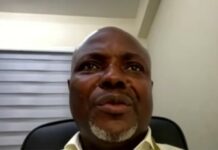

The Chief Executive of the Minerals Commission, Isaac Andrews Tandoh, has described the Local Content Summit as the beginning of an annual platform to rally industry players around responsible resource management.
He issued a strong warning against fronting arrangements, where foreign businesses operate behind Ghanaian proxies. “Why do you lend your name to such agreements? Open your eyes you are being used,” he cautioned.
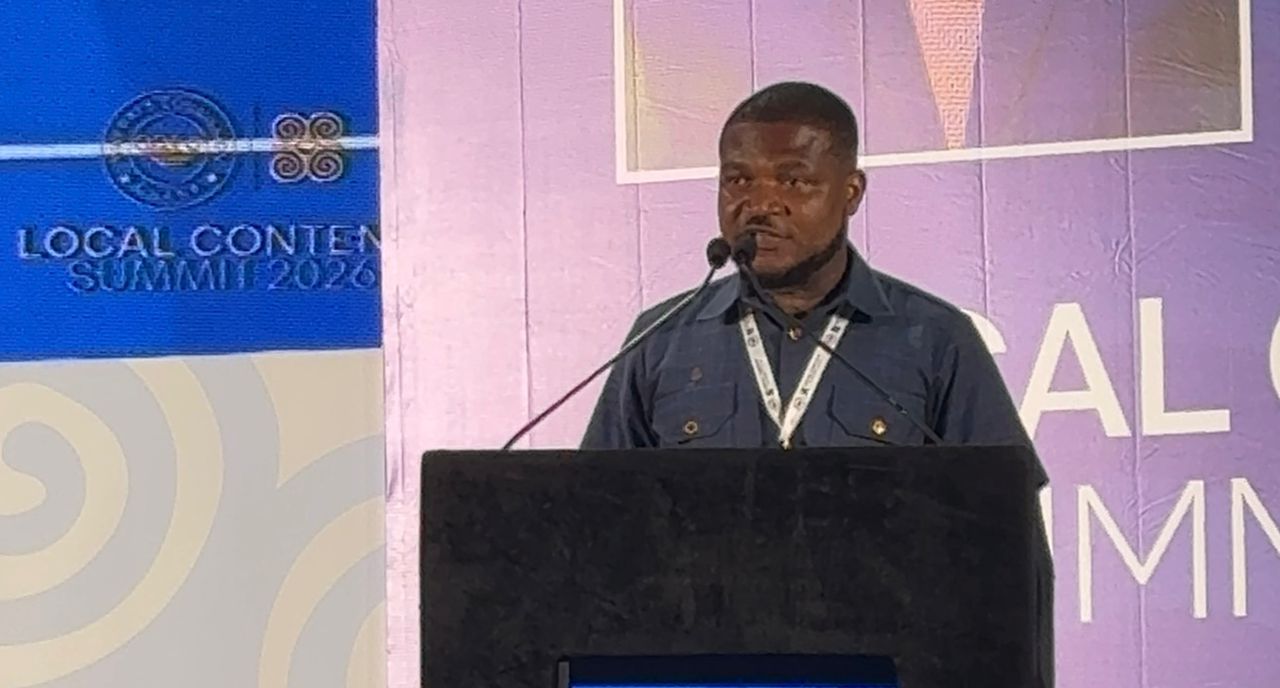
Mr Tandoah said this on February 18 while addressing participants at the maiden edition of the Local Content Summit in Takoradi, organized by the Commission under the theme “Strengthening Local Content and Indigenization: Building a Resilient Mining Sector in Ghana.”
Mr Tandoh also announced that the Commission is working on a new royalty regime and reviewing long-term leases that often outlive prevailing policies and regulatory systems.
“We are ready to support Ghanaian businesses, civil society organizations, local communities and other stakeholders to derive tangible benefits from the sector,” he stated.
Please read full speech below:
Long before this land was called Ghana, it was known to the world as the Gold Coast.
That name was a declaration of our identity, a testament to the wealth that lay beneath our feet and flowed through our rivers.
In the pre-colonial era, our forefathers mined this gold with ingenuity, using simple but effective methods, trading wisely with merchants who came from far and wide. They were active participants who understood the value of what they had.
Then came colonialism! And with it, the extraction began in earnest, not for our benefit, but for theirs. Our gold was shipped out unrefined elsewhere, and sold back to us at prices we could not afford.
So even though our people provided the labour, they never owned the wealth or the mines. And yet we had been told we were capable of managing our own affairs.
Your Excellencies, ladies and gentlemen, seventy years after Independence, we must ask ourselves: have we demonstrated that we are capable of managing our own affairs and taken ownership of our mineral wealth?
We know what the truth is.
- Why is it that in this day and age, foreign interests are able to hide behind Ghanaian names to satisfy regulatory requirements while retaining the control and all the benefits? Look at the scourge of galamsey today; more than half of it is a result of this unfortunate and unethical phenomenon.
To our Ghanaian brothers and sisters who lend their names to such arrangements: open your eyes. You are not empowering yourself; you are being
used to disempower your own people.
- Why do we still see very minimal or no equity stakes for Ghanaians in mining projects on our own soil? We watch as companies extract billions
in value while our people hold little more than the promise of employment.
- Why do we grant mining leases spanning decades—fifteen, twenty, even thirty years—locking our resources into arrangements that outlast governments, outlast policies, and too often outlast any meaningful benefit to our communities.
- Why do we still have minimal local participation in an industry that powers our economy? Yes, we have made gains. The Chamber of Mines reports that some companies now employ up to 42% of their workforce from local communities— and we commend that. But employment is not the same as ownership. Labour is not the same as control. Our people are working in the mines, agreed, but do they own the mines?
The answers to these questions, Mr. President, are the reason why your vision is not just important; it is empirical. In your Reset Agenda, you gave us a clear mandate: Ensure that Ghanaians own, participate in, and benefit from our mineral wealth. You reminded us that the resources God deposited in our soil were not meant to enrich foreign lands, but to build our infrastructure.
Under the dynamic and decisive leadership of our Sector Minister, Hon. Emmanuel Armah-Kofi Buah—a man who has thought it wise to convene all stakeholders here today to share ideas on how to empower Ghanaians, build local capacity, and power our economy—the Minerals Commission has run with that vision.
Let me share with you what we have done in just over twelve months.
With Hon. Buah’s guidance, today, we can report that we have revoked over 300 small-scale licenses that were fraudulently acquired and those that
were held by persons who had no business holding them. And this was not a political exercise, but a professional one with all due processes followed.
For far too long, certain provisions of our mining laws existed only on paper. One such provision is the role of District Mining Committees, which, under the law, must make recommendations before any license is issued. Under the leadership of the Minister, we have operationalised these committees, ensuring that no license is processed without their input.
Again, you will recall that the Minister announced that we have completed a comprehensive overhaul of the Minerals and Mining Act, Act 703, and the Minerals and Mining Policy 2014. We have introduced legislative instruments to tighten the loose ends that have been exploited for years, and revoked LI 2462, which previously permitted mining in forest reserves.
We have also introduced a medium-scale licensing category to fill the gap between small-scale and large-scale operations, expanding opportunities for responsible Ghanaian miners.
We have also proposed sweeping reforms to stability and development agreements. Development agreements are being phased out entirely because they have been abused—we have seen companies use revenue from Ghana to buy mines elsewhere while refusing to develop the mines and even pay basic obligations to our district assemblies. That cannot continue.
We are introducing a new royalty regime that captures more value for the state when gold prices are high. This is not about punishing investors. It is
about ensuring that when God blesses us with high prices, Ghanaians also share in that blessing.
Mr. President, Nana Chairman, this is perhaps the most significant work we have undertaken. We have gone back to the foundation. We have reviewed the policy framework in its entirety. We have examined the Act section by section, clause by clause, including the local content provisions. We are ensuring that local content is not a compliance checkbox but a strategic imperative embedded in every mining agreement, every procurement decision, every employment policy.
The reforms also include tougher local-content rules for in-country procurement and support for Ghanaian firms.
Your Excellency, Honourable Minister, Distinguished Stakeholders, On behalf of the Minerals Commission, I want to state clearly and firmly: We are ready. We are ready to run with the President’s vision. We are ready to implement the reforms under the Minister’s leadership. We are ready to enforce the laws without fear or favour.
We are ready to partner with genuine investors—those who see Ghana not merely as a destination for extraction, but as a partner in progress.
We are ready to support Ghanaian entrepreneurs who are willing to invest in their own capacity, professionalise their operations, and meet global standards.
We are ready to work with traditional leaders, civil society, and local communities to ensure that mining delivers tangible benefits to those who bear the environmental and social costs.
And we are ready to confront those who seek to undermine this vision—whether through fronting, through regulatory evasion, or through the exploitation of loopholes we are now closing.
Your Excellency, thank you for your visionary leadership and your unwavering commitment to the people of Ghana.
Honourable Minister, thank you for your decisive action and for bringing us all together under this roof to share ideas and forge partnerships.
Distinguished stakeholders, thank you for your commitment and for honouring our invitation. Thank you for believing that Ghana can and must do better.
Together, let us build a mining sector that our children will be proud of. Not just for what we extracted, but for what we built. Not just for the wealth we took out, but for the capacity we left behind.
God bless us all.
Thank you