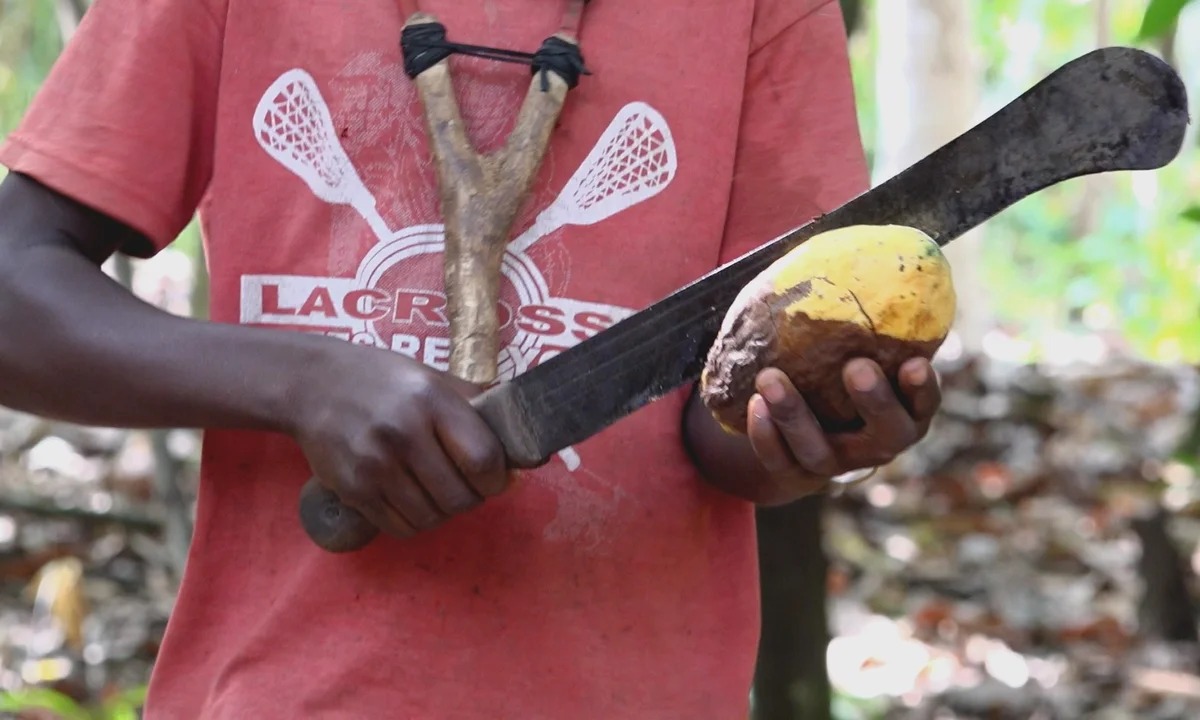

An American Youtuber, MrBeast, came to Ghana and reportedly spent nearly $10 million building a village for families affected by child labour.
But there is an important detail that should not get lost in the excitement surrounding this project.
This village is not in some forgotten corner of the world.
It is the Abna Dakwa Village, in the Eastern Region of Ghana, in a cocoa-farming area.
And that matters.
Because cocoa is not some insignificant crop in Ghana.
Cocoa has helped build this country.
For generations, Ghana has exported cocoa to the world. It brings foreign exchange into our economy, supports hundreds of thousands of farming households and remains one of the commodities Ghana is internationally known for.
Yet in a community connected to that same industry, children have been vulnerable to child labour.
Then an American YouTuber arrived.
Jimmy Donaldson, popularly known as MrBeast, and his partners reportedly spent nearly $10 million creating an entire community around the problem.
A school for more than 300 children.
Ten homes for teachers.
A medical clinic.
Clean drinking water.
Solar power.
Sanitation.
A marketplace.
Agricultural facilities.
A football field.
A playground.
And free school meals for five years.
That is impressive.
But it should also make Ghana uncomfortable.
Because MrBeast did not come to Ghana to solve a problem we did not know existed.
We knew!
Child labour has been documented in Ghana for years, particularly in agriculture, cocoa-growing communities, fishing and other informal sectors.
UNICEF estimates that about 21% of Ghanaian children aged 5–17 are involved in child labour, with the problem more prevalent in rural areas.
So when a foreign YouTuber can enter one of our cocoa-growing communities, identify the conditions helping to keep children vulnerable to labour and mobilise millions of dollars to address them, Ghana has every reason to ask itself one simple question:
What have we been doing?
And this question should not be directed only at Jubilee House or a ministry in Accra.
There is a local government structure.
There is a Municipal Assembly.
There are government agencies responsible for education, health, water, agriculture, social welfare and child protection.
And there is political representation.
The Member of Parliament for Suhum is Frank Asiedu Bekoe.
This is why the conversation cannot end with applauding MrBeast.
It must also become a conversation about responsibility.
What was known about the conditions in this community?
What interventions existed before MrBeast arrived?
What support had families received?
What had been done about the educational and infrastructure gaps?
And what role did the state, and its local institutions play before a private philanthropist decided to spend millions addressing them?
These are questions worth answering.
Government has programmes. But look at the gap.
To be fair, the Ghanaian government has not done nothing.
Ghana has laws against child labour.
It has the Accelerated Action Plan Against Child Labour 2023–2027.
It has child-labour monitoring systems.
It works with organisations such as UNICEF and the International Labour Organization.
And in 2026, Ghana became an Alliance 8.7 Pathfinder Country, committing itself to accelerate efforts against child labour, forced labour, human trafficking and modern slavery.
Government institutions have also been involved around MrBeast’s wider intervention. Local government and education authorities have been identified among institutions supporting parts of the broader programme, including the related school-meals initiative.
So no, this is not an argument that government has literally done nothing.
The argument is much simpler:
Has what government has done been enough?
Because while Ghana has policies and action plans, a private organisation has gone into a Ghanaian cocoa-growing community and built physical infrastructure around the problem.
Not another report.
Not another conference.
Not another promise.
Infrastructure.
A school.
Teacher accommodation.
A clinic.
Water.
Solar power.
Sanitation.
Food.
Agricultural support.
Income-generating opportunities.
That contrast is difficult to ignore.
So who paid for the $10 million village?
This is perhaps the most important question.
Based on the publicly available information I could verify, there is currently no clear evidence that the Government of Ghana financed the reported nearly-$10 million construction of Abna Dakwa Village.
The project is associated with Beast Philanthropy and a network of private, philanthropic and development partners.
Government institutions appear within the wider ecosystem surrounding the programme, particularly around education and local implementation.
But let us be clear:
Cooperation and financing are not the same thing.
If the Government of Ghana, the Municipal Assembly, the MP’s office or another state institution provided land, money, personnel, infrastructure or another substantial contribution towards building the village, then that contribution deserves to be clearly put on record.
Because otherwise, the story travelling around the world is brutally simple:
MrBeast spent nearly $10 million building a village in Ghana to help children affected by child labour in a cocoa-growing community.
And Ghana is the country where he had to build it.
That should bother us .
Not because MrBeast is American.
Not because Ghana should reject foreign assistance.
And certainly not because there is anything embarrassing about someone helping Ghanaian children.
It should bother us because the conditions he is trying to address are not new.
We knew poverty was pushing some families towards child labour.
We knew some rural communities lacked adequate educational infrastructure.
We knew some communities struggled with water and sanitation.
We knew vulnerable farming households needed stronger incomes.
We knew attracting and retaining teachers in deprived communities was difficult.
And we knew children were working in parts of the cocoa sector.
We knew.
The question is why knowing has not produced enough action.
Ghana’s problem is not a shortage of policies
We have plans.
We have committees.
We have laws.
We have ministries.
We have conferences.
We have international commitments.
But vulnerable children cannot live inside policy documents.
A child cannot sit inside an action plan.
A policy cannot replace a classroom.
A committee cannot provide clean drinking water.
A conference cannot house a teacher.
And telling a poor cocoa-farming family not to allow a child to work does not automatically change the economic circumstances that made that child’s labour valuable to the household.
This is one area where the Beast Philanthropy intervention deserves serious attention.
It does not simply say:
*“Take the children off the cocoa farms.”*
It asks what happens next.
If you want the child in school, where is the school?
If you build the school, where will the teachers live?
If the child attends school, what will the child eat?
If poverty contributes to child labour, how does the household earn enough to survive?
If the community lacks basic services, where are the water, healthcare, sanitation and electricity?
That is why this project is bigger than a nice school built for a viral YouTube video.
It attacks several sides of the problem at once.
But MrBeast cannot become Ghana’s development plan
This is where we have to draw the line.
MrBeast deserves credit for what he and his partners have done.
But Ghana cannot sit around waiting for another philanthropist with hundreds of millions of followers to discover the next struggling community.
Because what about the village that MrBeast never visits?
What about the cocoa farmer whose child never appears in a YouTube video?
What about the community that never attracts a $10 million philanthropist?
There are thousands of communities that will never trend on social media.
Their children matter too.
That is where the state comes in.
Philanthropy can help.
Philanthropy can experiment.
Philanthropy can fill gaps.
But philanthropy cannot replace government.
And that brings us back to cocoa.
How can cocoa communities still look like this?
This is perhaps the contradiction Ghana needs to confront most seriously.
These are communities connected to an industry from which Ghana has earned enormous economic value for decades.
Cocoa.
We celebrate it.
We export it.
We tax economic activity around it.
We build national identity around it.
It brings foreign exchange into the country.
Chocolate manufacturers around the world depend on cocoa grown in countries such as Ghana.
Yet some of the families at the very beginning of that supply chain remain vulnerable enough that child labour continues to be a problem.
Think about that.
The world enjoys the chocolate.
Ghana earns from the cocoa.
Companies build billion-dollar businesses around the commodity.
Yet some of the people actually growing it remain poor enough that keeping children completely away from labour can become difficult.
That contradiction deserves far more attention.
Building schools helps.
Providing meals helps.
Providing water helps.
But ultimately, cocoa farmers must also be able to earn enough to support their households without children’s labour becoming part of the family’s survival strategy.
And after MrBeast leaves ?
This may actually be the biggest question of all.
The cameras will eventually leave.
The video will stop trending.
The internet will move on.
But Abna Dakwa will still be in Ghana.
Who maintains the water systems?
Who replaces damaged solar equipment?
Who keeps the clinic functioning?
Who pays and retains the teachers?
Who maintains the school?
What happens when the five-year school-meals programme ends?
Who makes sure the children do not return to labour?
That is where government involvement becomes even more important.
Because MrBeast can build the infrastructure.
Ghana has to help make it last.
And this is where the MP, the Municipal Assembly, Ghana Education Service, health authorities, social welfare agencies and central government all have roles to play.
Not simply attending ceremonies.
Not taking photographs.
Not issuing statements thanking donors.
Sustainability.
If this model works, study it.
Measure it.
Find out what actually keeps children in school.
Find out whether household incomes improve.
Find out whether child labour declines.
Then ask whether parts of the model can be reproduced in other vulnerable cocoa-growing communities.
Because Ghana cannot build national development around the hope that another MrBeast will come.
The uncomfortable truth
MrBeast’s project should not embarrass Ghana because a foreigner helped Ghanaian children.
It should make us uncomfortable because of what he found when he got here.
A cocoa-growing community needing better educational infrastructure.
Families vulnerable to child labour.
Teachers needing accommodation.
A community needing improved water, healthcare, sanitation and economic opportunities.
And these were not problems hiding thousands of kilometres away from the Ghanaian state.
They were here.
In the Eastern Region of Ghana.
In a cocoa-growing area.
Within a municipality.
Within a parliamentary constituency.
Within a country that has ministries, agencies, assemblies, MPs, policies and programmes specifically created to improve people’s lives.
That is why the conversation cannot end with:
“Thank you, MrBeast.”
Yes, thank him.
Thank Beast Philanthropy.
Thank the organisations and individuals who helped finance and implement the project.
But after the applause, Ghana must ask itself:
Why did this community need MrBeast in the first place?
And more importantly:
How many other Abna Dakwas are out there waiting for someone to notice them?
Because MrBeast has built one village.
Ghana has an entire country to take care of.
By Lois Dogbe