
One challenge the Effia-Kwesimintsim Municipal Health Directorate identified in promoting the Human Papillomavirus (HPV) vaccine was not the virus itself, but rumours spreading on social media and in neighbourhood conversations.
Though seemingly simple, the health directorate found an effective response after a series of failed attempts to counter the misinformation surrounding the vaccine.
Health authorities are now relying on indigenous languages after using English as their primary means of communication failed to achieve the desired results.
This approach has increased HPV vaccine uptake, but the proportion of people who have received it remains well below the number health authorities want to reach.
Although this approach has not yet brought vaccination coverage up to the health directorate’s target, officials consider the increase in uptake a positive development.
When rumours about the HPV vaccine began circulating in Effia-Kwesimintsim in the Western Region — including claims that the injection could cause infertility, miscarriages, or leave children unable to walk — health workers found that simply correcting the claims from behind a facility desk was not working.
Why the vaccine matters
Human papillomavirus is a common infection spread mainly through sexual contact. In most people, the body clears it. Persistent infection with certain high-risk types can change cervical cells and, over years, lead to cervical cancer. HPV is also linked to some other anogenital, oral, and throat cancers. Because progression takes years, cancers diagnosed today reflect infections acquired long ago, so prevention must start before exposure.
Ghana is estimated to see about 3,000 new cervical cancer cases and 1,800 deaths each year. Older figures still in circulation — such as 2,797 cases and 1,699 deaths — come from a 2021 ICO/IARC fact sheet. These are modelled estimates, not counts of recorded cases.
HPV genotype surveillance data is limited and old. A study of 256 cervical cancers diagnosed at Korle Bu Teaching Hospital, covering January 2004 to December 2006, found HPV DNA in 230 (89.8%). HPV 18 (47.4%), HPV 59 (42.2%), HPV 45 (37.4%), and HPV 16 (9.0%) were the most common types, and 52.2% of positive samples carried more than one type. The percentages overlap and are not additive. The study covered one hospital and was conducted over a specific period.
The most recent data come from samples submitted for testing between July 2022 and March 2025. HPV positivity in the Ghana screening group was 34.9%, and 39.2% of positive cases carried multiple genotypes. HPV-39 was the leading genotype in that group, especially among women under 30, followed by HPV-53 and HPV-68. In clinician-collected samples, HPV-16 was the most common.
Screening is the second line of defence, though it remains underexplored. Ghana’s 2023 STEPS survey found that only 3.6% of women had ever been screened for cervical cancer. Vaccination reduces infection risk but does not replace screening.
Ghana’s first nationwide HPV campaign began on Oct. 8, 2025, aiming to reach 2.4 million girls aged 9 to 14 years, in and out of school. WHO reports 1,825,425 girls vaccinated, or 82% of those eligible. The vaccine is now part of routine immunisation, and the schedule has moved to a single-dose regimen.
Nationally, then, the campaign reached most eligible girls, but in Effia-Kwesimintsim it reached far fewer.
Rumours travel faster than health messages
Mamuna Garriba, a senior community health nurse at the directorate, said parents raised a consistent set of concerns during the HPV vaccination exercise.
Some compared the HPV vaccine to the COVID-19 vaccine and cited side effects associated with COVID-19 vaccination. Others asked why children aged 9 to 14, who were not sexually active, needed a vaccine against cervical cancer. Many wanted to know whether the vaccine would affect their children’s fertility later in life.
Garriba said claims circulating in the communities linked vaccination to menstrual problems, infertility, and miscarriage. She said parents encountered those claims through social media and conversations with neighbours.
“Sometimes when one person hears something and tells another person, it creates fear,” Garriba said. “The other parent may also begin to think that the same thing can happen to her child.”
The consequences, she said, are far-reaching. Health teams sometimes travel to communities with vaccines and medicines, only to be turned away by parents who have heard negative claims about them. Some ask the health workers to return later, while others decline without explanation.
“Sometimes you go with the vaccines to the community, but because of what somebody has heard, the parent will not allow the child to take it,” she said.
Garriba said doses that go unused in this way risk being wasted if they expire before they can be administered.
Language Dynamics
The directorate had targeted 6,955 children aged 9 to 14. For several weeks, rumours kept uptake low. The first approach — using English and correcting claims at health facilities — did not shift parents’ minds.
The team then changed who spoke and how they delivered the message. Emelia Kpodo, a senior health promotion officer, said staff are matched to communities by language. In Apremdo, Whindo, Kwesimintsim, Apollo, Anaji Fie, Adientem, and Assakae communities, where Ahanta is widely spoken, Ahanta-speaking health officers run the sensitisation. Nzema and Fante speakers are deployed elsewhere.
“When you have somebody who speaks the language of the community, it makes communication easier because the people feel that one of their own is part of the team,” Kpodo said.
_Education on routine vaccination and HPV at Assakae Community Information Centre. Source: Effia-Kwesimintsim Health Directorate._
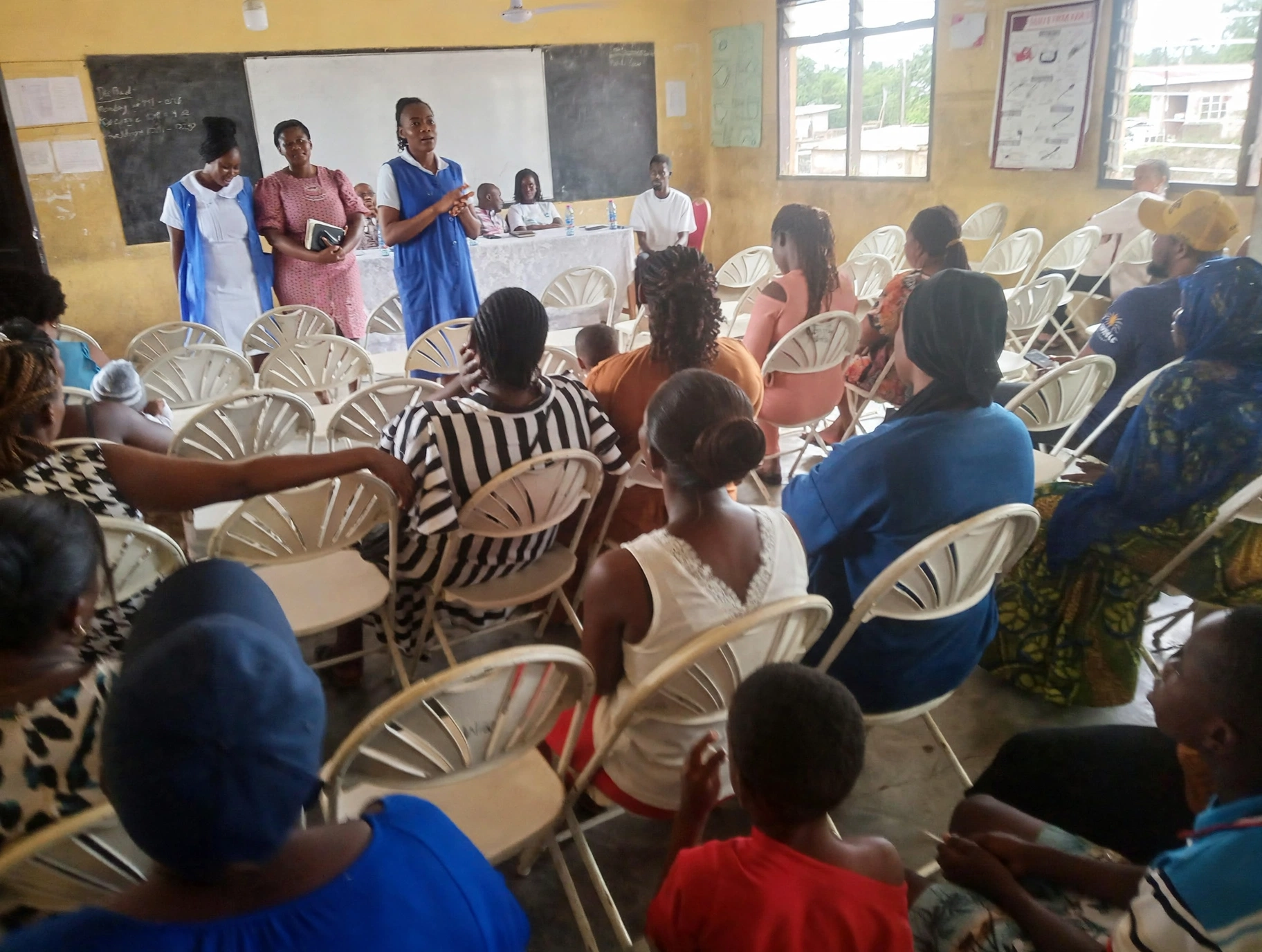
The work runs through four channels: community education, face-to-face discussions, community information centers, and school engagements such as PTA meetings where parents ask questions directly.
The method matters as much as the language. Health workers do not start by telling parents a rumour is false. They explain what HPV is and what the vaccine does, then invite parents to say what they have heard in their own words. Afterwards, staff answer using familiar expressions and examples. Kpodo describes the sequence as listening to the concern, finding where it came from, and then responding with accurate information.
_Emelia Kpodo, Senior Health Promotion Officer at Effia-Kwesimintsim Health Directorate. Source: DUBAWA_
The evidence: imperfect, but measurable
After sustained education in local languages, 2,372 (34%) of the 6,955 target children had been vaccinated. Kpodo described this as a significant improvement on where the exercise stood before the language-led engagement.
By the directorate’s own numbers, about two-thirds of the target group — 4,583 children — had still not been vaccinated at that point. The result is real progress, not target coverage.
_Parents being educated in their local dialect at a school PTA meeting. Source: Effia-Kwesimintsim Health Directorate._
Kpodo acknowledged that some parents remained hesitant after the engagements. Whether the model can be sustained is a separate question. It depends on having staff who speak the relevant language in each community, a constraint the directorate has not quantified.
_Community engagement at Anaji Fie. Source: Effia-Kwesimintsim Health Directorate._
_A student receiving the vaccination. Source: Effia-Kwesimintsim Health Directorate._
Why it may matter elsewhere
The Effia-Kwesimintsim experience points to a simple mismatch that health communicators across Ghana face: a rumour that reaches a parent in Ahanta from a neighbour is rarely undone by a correction delivered in technical English at a health facility.
For Kpodo, the sequence is what matters: listen to the concern, find out where it came from, then respond with accurate information.
When misinformation spreads in the language of the community, the correction may have to speak that language too.
By Portia Cudjoe