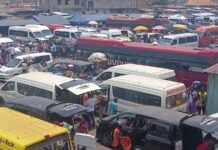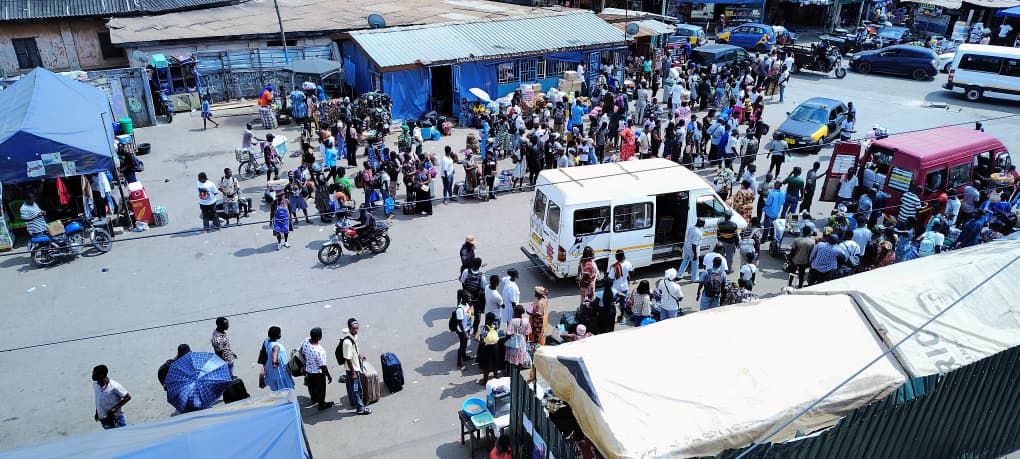

For the past four days, passengers at the Ghana Private Road Transport Union (GPRTU) terminals in Accra, Kumasi, and Volta within Takoradi have been forced to endure the scorching sun for hours, waiting in long queues to board buses to their destinations.
Public commercial vehicles have become scarce at the terminals, and transport managers have been able to do little to ease the congestion that builds up with each passing hour.
On average, passengers spend about five hours in line before boarding a bus. Although the GPRTU anticipated increased demand due to the surge of visitors to Sekondi-Takoradi during the Christmas season, the sheer volume has overwhelmed their capacity.

In response to the crisis, some operators aligned with the GPRTU have deployed Toyota Voxy and Sprinter buses to ease pressure, but these efforts remain insufficient. Most passengers prefer the larger, longer buses or Toyota Hiace vehicles, leaving only a few willing to compromise their comfort for the smaller alternatives.
But limited vehicle options are not the only issue. Some transport operators are charging exorbitant fares—in some cases, twice the normal rate. Additionally, many buses arrive at the terminal nearly full, with only about three to four seats available on average for passengers who have waited for hours.
The situation has persisted for days, leading to visible frustration. Some passengers have vented their anger at ticketing officers, accusing them of bypassing the queue to allow others who did not wait to board.

Intervention by STC
The State Transport Company (STC) in Takoradi is currently operating with a reduced fleet and is unable to fully respond to the transportation crisis at the GPRTU terminals.
Regional Manager Felix Gakpo explained that STC only intervened on Friday, December 26, and Sunday, December 28, by releasing a total of 15 buses to help ease the situation.
“We only came to their aid last Friday with eight buses—some to Accra, Kumasi, and others to the north. On Sunday, we realized that even though our buses were full, there were still stranded passengers at the Accra [GPRTU] station… so we deployed additional buses there,” he said.
“As of now, we don’t have a single bus in the yard. All have been deployed to Accra and the north. We’ve only managed to dispatch two buses since morning, with one more moving this afternoon,” he added.

Mr. Gakpo noted that STC is not in a position to further assist GPRTU, as their entire fleet is fully booked.
“All our buses have been booked. As we speak, bookings for the next four days are complete. We are aware of the situation but currently lack the fleet to help.”
Compounding the issue, more than a dozen STC buses are grounded due to mechanical faults. It remains uncertain whether any can be repaired soon enough to supplement the active fleet.

Causes of the Crisis
A preliminary assessment by the GPRTU points to two major causes of the vehicle shortage: severe traffic congestion on the Kasoa-Winneba and Inchaban-Kojokrom sections of the N1 highway and recurring mechanical breakdowns attributed to the poor state of the roads.
Western Regional Chairman of the GPRTU, Joseph Simons Cudjoe, also revealed that many drivers are unwilling to make return trips to Accra from Takoradi, mainly due to fatigue. He added that low passenger demand in Accra further discourages drivers from heading back.
“The passenger traffic is here in Takoradi, but we aren’t seeing corresponding numbers in Accra to motivate drivers to return,” he emphasized.
Another contributing factor is the high demand for buses booked by churches across the country for December 31 night events. Many of these buses were rented long before Christmas, further depleting available transport during the peak season.