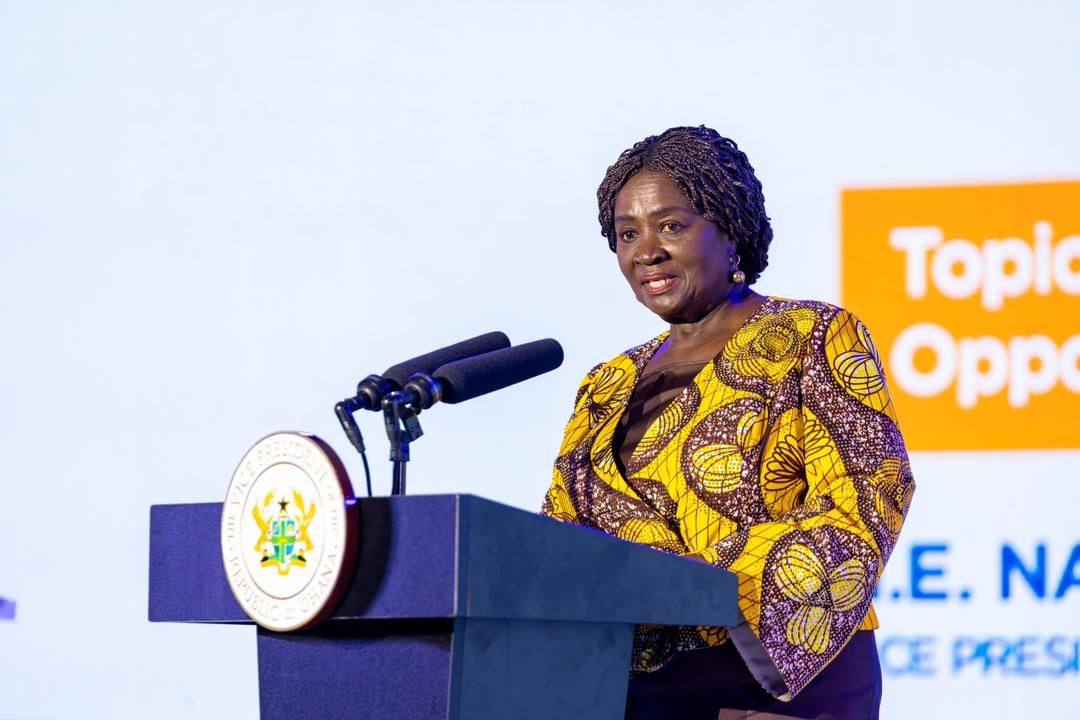

Vice President Professor Naana Jane Opoku-Agyemang has condemned sexual exploitation in workplaces and educational institutions, describing practices such as “sex for jobs” and “sex for grades” as abuses of power that undermine human dignity, institutional integrity and national development.
Speaking at a conference on sexual exploitation in Accra on November 5, the Vice President called for stronger accountability mechanisms and effective enforcement of laws to protect victims and survivors of sexual harassment.
Delivering an address on the theme of promoting accountability and protecting people who have experienced abuse, Prof. Opoku-Agyemang said Ghana had adequate legal and policy frameworks to address such practices, but stressed that their effectiveness depended on proper implementation.
She cited the 1992 Constitution, the Labour Act, 2003, and the International Labour Organization’s Convention 190 on Violence and Harassment as important instruments for protecting people against abuse.
According to her, sexual exploitation in workplaces and academic institutions goes beyond individual misconduct, as it represents an abuse of authority, a violation of bodily autonomy and a breach of institutional trust.
“Sexual exploitation is a drain on national development,” she said, warning that such practices also result in lost productivity, wasted talent and declining public confidence in institutions.
The Vice President said government recognised the seriousness of the problem and was taking steps to strengthen institutional responses to gender-based violence and sexual harassment.
She pointed to the launch of the Affirmative Action Regulations, 2026, in support of the implementation of the Affirmative Action Act, 2024, as well as the revised National Gender Policy by the Ministry of Gender, Children and Social Protection.
She also highlighted collaboration between the Ministry and the ECOWAS Gender Development Centre to train stakeholders in the judicial, health and social sectors to improve the prevention of and response to gender-based violence and sexual harassment.
On the education front, she said the Ministry of Education and the Ghana Education Service had established procedures for reporting, investigating and sanctioning sexual harassment in schools.
National guidelines, she added, also provide a framework for tertiary institutions to develop and enforce policies against sexual harassment.
However, Prof. Opoku-Agyemang cautioned that government policies and legislation alone would not eliminate sexual exploitation, insisting that institutions must demonstrate a genuine commitment to accountability.
She called for independent and confidential reporting channels, particularly in situations where individuals accused of misconduct wield influence over victims’ employment, promotions or academic progress.
She said victims must be able to report incidents without intimidation, retaliation or the fear of losing opportunities.
The Vice President further urged institutions to ensure that complaints were investigated promptly, fairly and thoroughly, with appropriate sanctions imposed on persons found culpable.
She emphasised that preventing sexual harassment should not depend solely on complaints from victims, but must involve properly resourced safeguards, responsible leadership and access to support services for survivors.
“Every workplace, public institution and educational establishment must be a place where people can pursue their ambitions without fear of sexual harassment or exploitation,” she said.
She urged government, public and private institutions, as well as citizens, to take collective responsibility for confronting the practice rather than treating it as an unavoidable reality.
Prof. Opoku-Agyemang said behind every case of sexual harassment or exploitation was a human being whose ambitions, confidence and sense of security could be severely affected.
She called on institutions to respect the dignity and privacy of complainants while ensuring that people who abuse positions of authority are held accountable.
The Vice President strongly appealed for a society where opportunities in employment and education are not tied to sexual favours.
“No job or academic qualification should come at the price or the cost of anyone’s dignity, and no person entrusted with authority has the right to demand that dignity,” she said.
By Evelyn Tengmaa