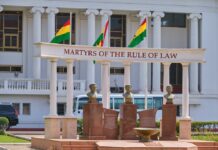

The Supreme Court has dismissed an application seeking to join the Office of the Special Prosecutor (OSP) as a party to a constitutional action challenging aspects of the Office’s powers under law.
Private Legal practitioner Noah Adamptey has filed a suit challenging the constitutionality of Parliament’s decision to set up the OSP.
In court on Tuesday, January 27, lawyers for the OSP led by Dr Isidore Tufuor argued that the reliefs being sought touch directly on the mandate of the OSP as provided under the Office of the Special Prosecutor Act, 2017 (Act 959).
Moving the application for joinder, the counsel for the applicant, told the court that the plaintiff’s writ raised constitutional questions relating particularly to Sections 4 and 33 of Act 959.
He clarified that although the suit appears to be against the state, it is not a challenge to the existence of the OSP as an institution but rather to the constitutionality of some of its powers.
Dr Tufuor, therefore intimated that the nature of the reliefs sought makes the OSP a necessary party whose presence would enable the court to effectively determine the issues before it.
However, the Deputy Attorney-General, Dr Justice Srem-Sai, opposed the application, insisting that the OSP has no interest in the suit that warrants its joinder.
“It is the creator who is to answer for the creation,” the Deputy Attorney-General argued, stressing that the OSP was established by an Act of Parliament and that any challenge to its legal framework must be answered by the state through the Attorney-General.
He further submitted that the Office does not have any proprietary or private interest in its own creation and, therefore, cannot be described as a necessary party to the action.
Supporting this position, Noah Adamptey, the applicant contended that the role of the OSP had been “gravely misconstrued” by the applicant.
He maintained that the Office does not stand to gain or lose anything personally from the outcome of the case and should not be drawn into a constitutional dispute concerning legislative action.
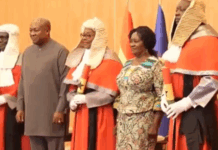
After hearing submissions from all parties, the panel of the Supreme Court, presided over by Justice Baffoe-Bonnie, ruled that the OSP is not a necessary party to the suit.
“We have reviewed the application and the processes filed,” the court said.
“Having heard all counsel on their submissions, we are of the view that the Office of the Special Prosecutor is not a necessary party to this suit.”
The court consequently refused the application for joinder, allowing the substantive constitutional case to proceed without the Office of the Special Prosecutor as a party.
By Laud Adu Asare