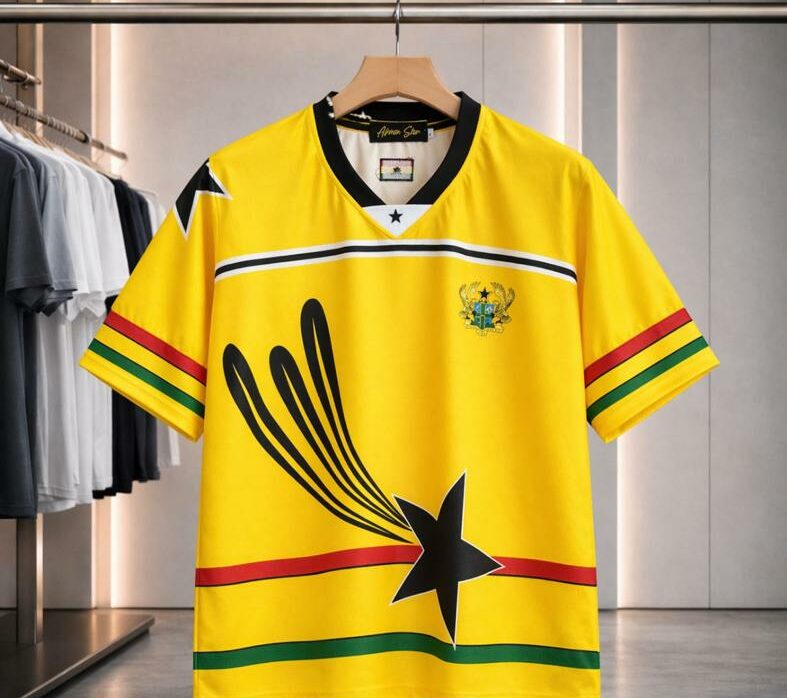

The Oxford Street of Osu in Accra becomes a street of jerseys in every World Cup season.
Boys and girls wear them. Men and women wear them. We call it patriotism.
The Ghana Football Association says we should “Bring Back the Love”. So come tournament season, the streets of Accra change their face. Red, gold and green take over the pavements.
Vendors stretch lines of jerseys from shop fronts to metal tables, and the colours catch the sun until the whole street glows. Young men move through the traffic with bundles on their heads, calling out prices above the horns and the music.
Buyers press close, fingers running over fabric, holding jerseys to their chests to check the fit. The ones with only the Black Stars crest sell well. But the ones that carry the Coat of Arms sell faster. Vendors know this. They tell customers the crest makes the jersey look more Ghanaian.
They say it feels more official. And fans buy because love for country makes us reach for the boldest symbol we can find. Yet few of us stop to ask whether the symbols we stitch onto our chests belong to us by right, or only by permission.
The law on this matter is old and strict, and most Ghanaians do not know how far it reaches. Four statutes govern the use of the National Flag and Coat of Arms. The first and most direct is the Flag and Arms Protection Act, 1959 (Act 61).
This law provides that no person shall use, display or wear the Ghana Flag or the Coat of Arms or any part of them or anything that resembles them without obtaining a licence from the Minister for the Interior. That provisi on covers exactly what happens when manufactured or imported jerseys printed with the Coat of Arms are spread on tables along Oxford Street and sold for cash.
The punishment for breach of this law is a fine or imprisonment on summary conviction. The Act however permits exceptions only for the President, Ministers and members of security agencies acting in official capacity, and for any other person who obtains a licence from the Minister for the Interior.
This means official kit manufacturers like PUMA may be covered to print the “Black Star” on the jersey, while vendors selling on the street are not permitted to cause the manufacture of these jerseys with the Coat of Arms printed on them.
The Criminal Offences Act, 1960 (Act 29) adds another layer of protection, and makes it a misdemeanour for any person who does an act with intent to insult the official national flag or emblem of Ghana or any pictorial reproduction of the flag or emblem. Think of a jersey tossed on the floor after a painful defeat, or used to wipe a dusty table and then forgotten.
For commercial traders, the Trade Marks Act, 2004 (Act 664) imposes even stricter liability, and makes it an offence for any person to use a national badge, seal, device, emblem or flag without lawful authority in a manner likely to lead the public to believe that the person is authorised by the Government to use such badge, seal, device, emblem or flag. The punishment for breaching this law is a fine or a term of imprisonment not exceeding six months or both.
Why do these laws exist. Step back and see the Flag at Independence Square rising in the morning wind, folding over the coffin of a soldier, standing behind our team at the World Cup. The Coat of Arms tells our story in pictures.
A shield holds our colours. An eagle spreads its wings above. A lion stands guard on the other side. Our motto sits beneath them all, Freedom and Justice. These are not decorations. They are our identity.
If every vendor on Oxford Street or at the Makola market can sell jerseys with these symbols without control, then the symbols will lose meaning. If the eagle can be redrawn by any printer, the eagle will lose its power and significance.
The law therefore keeps these symbols under state control and permission is given only to those who qualify. The cheers while supporting the Black Stars of Ghana do not suspend the law. The reality on the ground is different.
Walk Oxford Street or any match viewing centre on match day and the evidence is everywhere. Jerseys with the Coat of Arms hang from racks that lean against walls and spill into the walkway. Children try them on, while fathers bargain over price.
It is tempting for Ghanaians to wave off misconduct with “chale, this no be anything and everybody dey do am”. However, public consensus does not create legal rights, and the absence of enforcement does not nullify an offence.
As it is popularly said, ignorance of the law is not an excuse. Now the law is known and the risk remains with every sale that happens under those jersey racks.
Some people will defend it with passion and say their hearts are in the right place. They will say love should cover the breach. But love is obedience. Love is shown when we respect what the law protects. If we allow the Flag and Coat of Arms to be sold freely on any table, then other symbols will fall next.
The Presidential Seal will appear on caps. The national anthem will be sampled for ringtones. Piece by piece our identity will thin out. That identity is what makes the Ghana football jersey matter in the first place.
Pride in the Black Stars must be guided by respect for the law. The greatest expression of love for Ghana is not found in the design on a jersey or pinned to a suit. It is found in the willingness to uphold the legal framework that protects what makes us Ghanaian.
This goes beyond the Coat of Arms on football jerseys. It covers the sale and use of the Coat of Arms and the National Flag on lapel pins, key rings, caps, bags and every item that now carries our symbols without permission.
As the nation rallies behind the team at the World Cup tournament, let our support be lawful. Let it be dignified. Let it endure. That, more than any crest on a shirt or pin on a lapel, is how we truly bring back the love.
By Jesse Akelimbona Adongo[1]
[1] Lawyer, (Litigation, Intellectual Property, Entertainment Law, Corporate & Commercial)