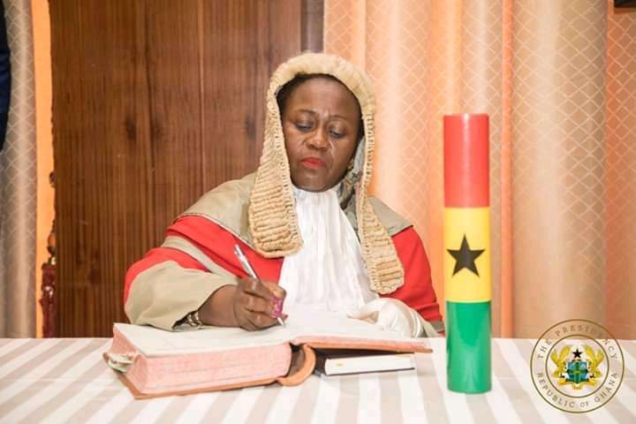

Chief Justice Gertrude Araba Esaaba Sackey Torkornoo has been removed by President John Dramani Mahama.
This follows the presentation of a report to him by the Committee tasked with investigating three petitions for her removal submitted by separate entities.
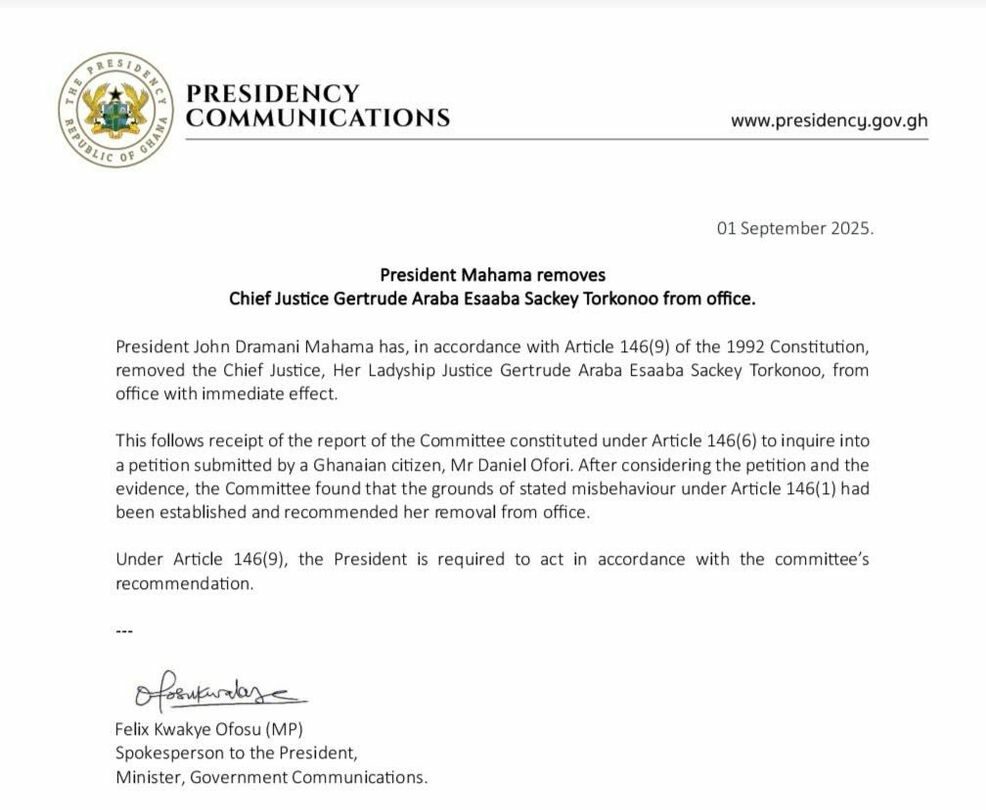
In a statement issued by the Minister in charge of Government Communications, Felix Kwakye Ofosu, on Monday, September 1, 2025, it was stated that the President acted in accordance with Article 146(9) of the 1992 Constitution.
According to the statement, the Chief Justice’s removal was based on a petition by Samuel Ofori, which was investigated by the Committee constituted in accordance with Article 146(6).
“After considering the petition and the evidence, the Committee found that the grounds stated misbehaviour under Article 146(1) had been established and recommended her removal from office,” portions of the statement contained.
The Committee was constituted after a prima facie case was determined in the three separate petitions that sought the removal of the Chief Justice from office. In line with constitutional requirements, President Mahama constituted a five-member committee to conduct the inquiry.
The committee was chaired by Justice Gabriel Scott Pwamang of the Supreme Court. Other members included Daniel Yaw Domelevo, a former Auditor-General; Major Flora Bazaanura Dalugo of the Ghana Armed Forces (GAF); and Professor James Sefah Dzisah, Associate Professor at the University of Ghana.
Prior to the commencement of the inquiry, the President, on April 22, 2025, suspended the Chief Justice after the prima facie case was determined from the three separate petitions, as enshrined in the Constitution.
Her suspension, carried out in line with Article 146(6) of Ghana’s 1992 Constitution, was done in consultation with the Council of State.
Subsequently, a five-member committee chaired by Supreme Court Justice Gabriel Scott Pwamang was appointed by the President to investigate the allegations.
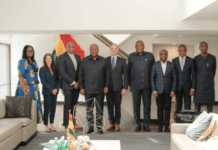
Justice Gabriel Scott Pwamang, after presenting the report to the President outlined what their mandate was.
“To the committee, our mandate and remit as set out under Article 146 Clauses (7) and (8) of the Constitution is clear and it is to inquire into the petitions in camera, hear the person against whom the petitions have been brought in her defence by herself or by a lawyer or other expert of her choice and then to make a recommendation to the President.”
Below is his full speech…
Your Excellency John Dramani Mahama, President of the Republic of Ghana, the Chief of Staff, the Attorney-General and Minister of Justice, other Ministers of State present, Legal Counsel to the President, Lawyer Marrietta Brew and other officials of the Presidency, representatives of the Media present, Ladies and Gentlemen.
Mr President, in March this year, you received three petitions pursuant to Article 146 of the 1992 Constitution for the removal of Chief Justice Gertrude A. E. Sackey Torkornoo, and the public was made aware of this fact. The subsequent processes, as dictated by the Constitution and the decisions of our Supreme Court, were followed, culminating in the establishment of our committee under Article 146, Clause 6 of the Constitution. The nation was further duly informed, and when we commenced our work on 15th May, 2025, the Minister of State for Government Communications was briefed and he notified the public about it.
There has been considerable interest in our work shown through comments and opinions by Ghanaians and international observers as well. However, the committee restrained itself all along from reacting even when blatant false statements made about members of the committee and our work. To the committee, our mandate and remit as set out under Article 146 Clauses (7) and (8) of the Constitution is clear and it is to inquire into the petitions in camera, hear the person against whom the petitions have been brought in her defence by herself or by a lawyer or other expert of her choice and then to make a recommendation to the President.
As I have said supra, three petitions were referred to us and though all three petitions seek for the same relief, each petition is distinct and would succeed or fail on its individual strengths and weaknesses.
Mr President, without disclosing the substance of the proceedings, and since in camera proceedings is not the same as in secret, we can state that in respect of the first petition, we received evidence by Mr Daniel Ofori, the first petitioner, through thirteen witnesses. Similarly, the Chief Justice in her defence also called twelve witnesses, including expert witnesses as she is entitled to do under the Constitution. The Chief Justice testified personally at the inquiry and was cross-examined. The committee received about 10,000 pages of documentary exhibits from both sides. There were four lawyers that represented the first petitioner and four lawyers represented the Chief Justice.
Advertisement
Mr President, after critical and dispassionate examination and assessment of all the evidence including the expert evidence against the provisions of the Constitution and the relevant laws, we have, without fear or favour, arrived at a recommendation on the first petition. The recommendation is contained in this envelop which we hereby hand over to you.
The second petitioner as well as the Chief Justice pleaded with the committee that the second petition which would have been next to be inquired into be adjourned and we acceded to their requests.
Accordingly, we shall be reporting on the second and third petitions in due time.
Thank you Mr President.
High Court throws out CJ Torkonoo’s judicial review application