
“I am a very ambitious coach. I come here with passion and the desire to achieve and win things.”
Those were Erik Tinkler’s first words after taking charge of Asante Kotoko, a club where success is not simply expected—it is demanded.
“It is also about developing for the future and making sure this historic club continues to produce fantastic footballers who can represent their national teams. Hopefully, I can bring that success to Asante Kotoko. That will be my purpose and my aim.”
The ambition is unmistakable.
But ambition alone will not restore Kotoko to the summit of Ghanaian football.
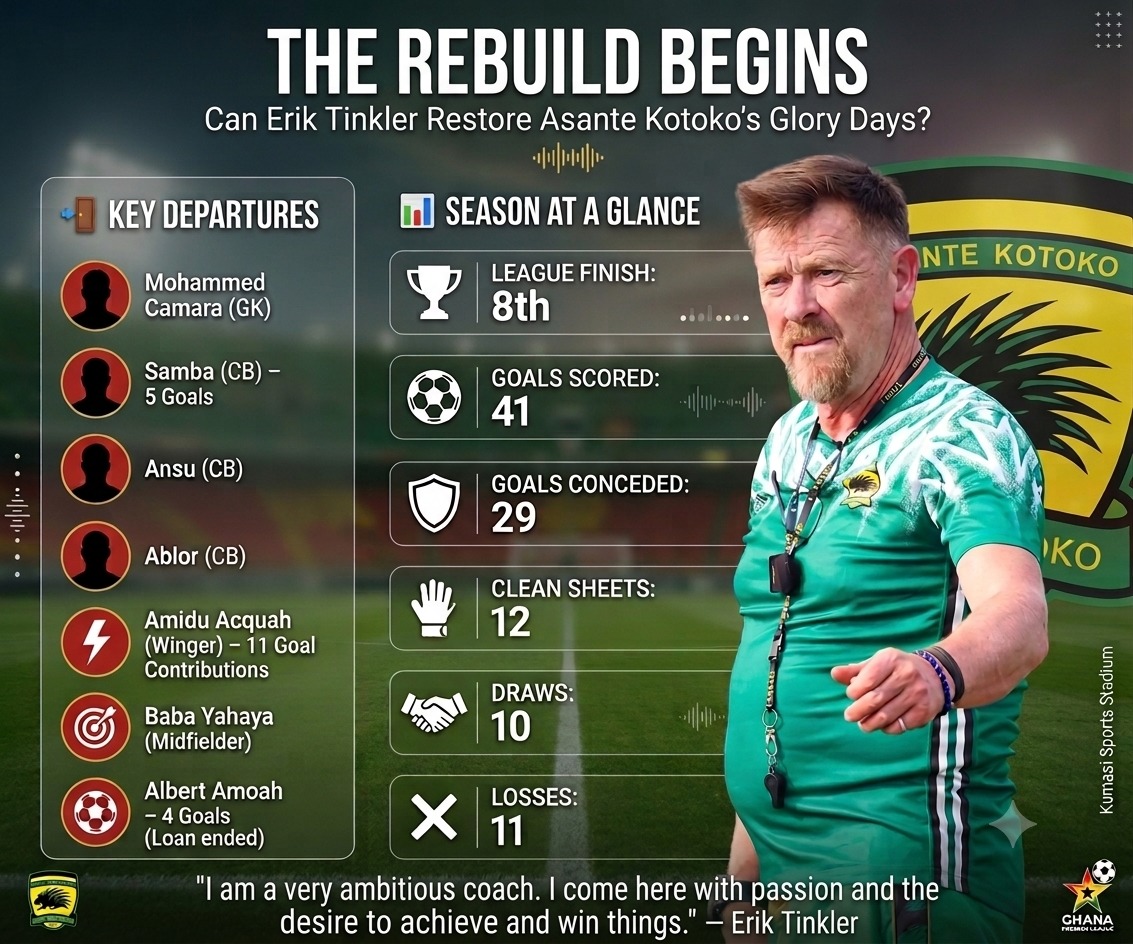
The South African has walked into one of the biggest rebuilding projects in the club’s recent history. After finishing a disappointing eighth in the 2025/26 Ghana Premier League, Kotoko now face another challenge off the pitch: replacing the core of a squad that has been dismantled before the new season has even begun.
The Numbers Don’t Add Up
At first glance, Kotoko’s statistics suggest they should have been genuine title contenders.
The Porcupine Warriors scored 41 league goals—their second-highest tally in the last four seasons—and conceded only 29, one of the league’s best defensive records.
Yet they finished eighth.
Season Goals Scored League Position
- 2022/23 42 4th
- 2023/24 36 6th
- 2024/25 37 4th
- 2025/26 41 8th
The contradiction is striking.
Their attack produced numbers good enough to compete near the top, while their defence remained among the league’s strongest. But football is not decided by season totals alone—it is decided by moments.
Kotoko’s campaign was marked by inconsistency. Big victories boosted their goal tally, but too often they failed to convert tight matches into wins. Ten draws and eleven defeats proved costly, leaving a side that looked impressive on paper but lacked the consistency required to sustain a title challenge.
A Squad That Has Been Torn Apart
If the eighth-place finish raised concerns, the transfer window has amplified them.
Since the end of last season, Kotoko have lost several experienced players, including goalkeeper Mohammed Camara, defenders Samba, Ansu and Ablor, winger Amidu Acquah, midfielder Baba Yahaya, while striker Albert Amoah has returned to his parent club following the expiration of his loan spell.
These departures represent far more than numbers on a squad list.
Camara was the dependable presence behind a defence that conceded just 29 goals and kept 12 clean sheets during the league campaign.
Samba was not only a commanding central defender but also an unlikely attacking threat, contributing five league goals from defence.
Further forward, Amidu Acquah finished the season with 11 goal contributions, making him one of Kotoko’s most influential attacking players, while Albert Amoah added four league goals during his loan spell.
Collectively, Kotoko have lost leadership, defensive stability and a significant share of their attacking output.
Perhaps most concerning is that, as of 21 July 2026, the club is yet to announce a single new signing.
For a club expected to compete for honours every season, time is becoming an increasingly valuable commodity.
More Than a Recruitment Drive
Replacing players is only part of Erik Tinkler’s challenge.
He must also restore confidence.
At Asante Kotoko, supporters expect league titles, not rebuilding projects. Every dropped point is scrutinised, every transfer debated and every coach judged against one of the richest histories in African football.
That makes recruitment critical.
Kotoko need more than squad depth. They need leaders who can organise the defence, players capable of replacing Acquah’s creativity and forwards who can consistently decide matches.
Beyond personnel, Tinkler must establish a clear tactical identity—one that transforms possession into points and consistency into a genuine title challenge.
The Verdict
Erik Tinkler has never hidden his ambition.
His opening message to Kotoko supporters was filled with optimism and a desire to return the club to its former heights.
But words alone will not rebuild one of Africa’s biggest clubs.
He has inherited a team that finished eighth despite posting statistics that suggested far greater potential. He has watched key players depart before the transfer window has gathered momentum. And with pre-season underway, he is still waiting for the first pieces of his new project to arrive.
The coming weeks could shape not only Kotoko’s fortunes but also the direction of Tinkler’s tenure.
The rebuilding has begun.
Now comes the difficult part—turning ambition into results.
Because at Asante Kotoko, rebuilding is never the destination.
Winning is.
By MuhammedKb