


The National Peace Council (NPC) and the Kofi Annan International Peacekeeping Training Centre (KAIPTC) have called for stronger trust and collaboration between communities and security agencies as Ghana intensifies efforts to prevent violent extremism.
They say building resilient communities, improving communication and strengthening civilian-security relations are critical to preventing extremist threats from gaining a foothold, particularly in northern Ghana.
Speaking at a regional community engagement workshop in Wa on Wednesday, September 30, 2026, Frank Wilson Bodza, Director of Conflict Management and Resolution at the National Peace Council, said conventional security measures alone could not effectively prevent violent extremism.
He said prevention must begin within communities by strengthening relationships between citizens and institutions responsible for their protection.
“Training and technical capacity are important, but they are not enough. Effective prevention depends fundamentally on relationships. It depends on whether communities trust the institutions responsible for their protection.”
Mr Bodza said citizens must feel confident enough to share information with security agencies, while security institutions must also listen to and respond to concerns from the communities they serve.
According to him, consultations conducted ahead of the programme identified trust, communication, accountability and institutional coordination as areas requiring sustained attention.
Noting that although Ghana continued to enjoy relative peace and stability, developments in the Sahel and neighbouring countries demonstrated that the country’s peace could not be taken for granted.
“Preventing violent extremism, therefore, requires us to look beyond conventional security responses. Prevention must begin much earlier.”
He said resilient communities must be able to withstand extremist narratives, while young people, women, traditional and religious leaders and marginalised groups should have meaningful opportunities to participate in community security efforts.
The Commanding Officer of the 10 Mechanised Battalion, Lt. Col. James Bampoe Palmer, who represented the Commandant of the KAIPTC, stressed the importance of civilian participation in maintaining peace and preventing violent extremism.
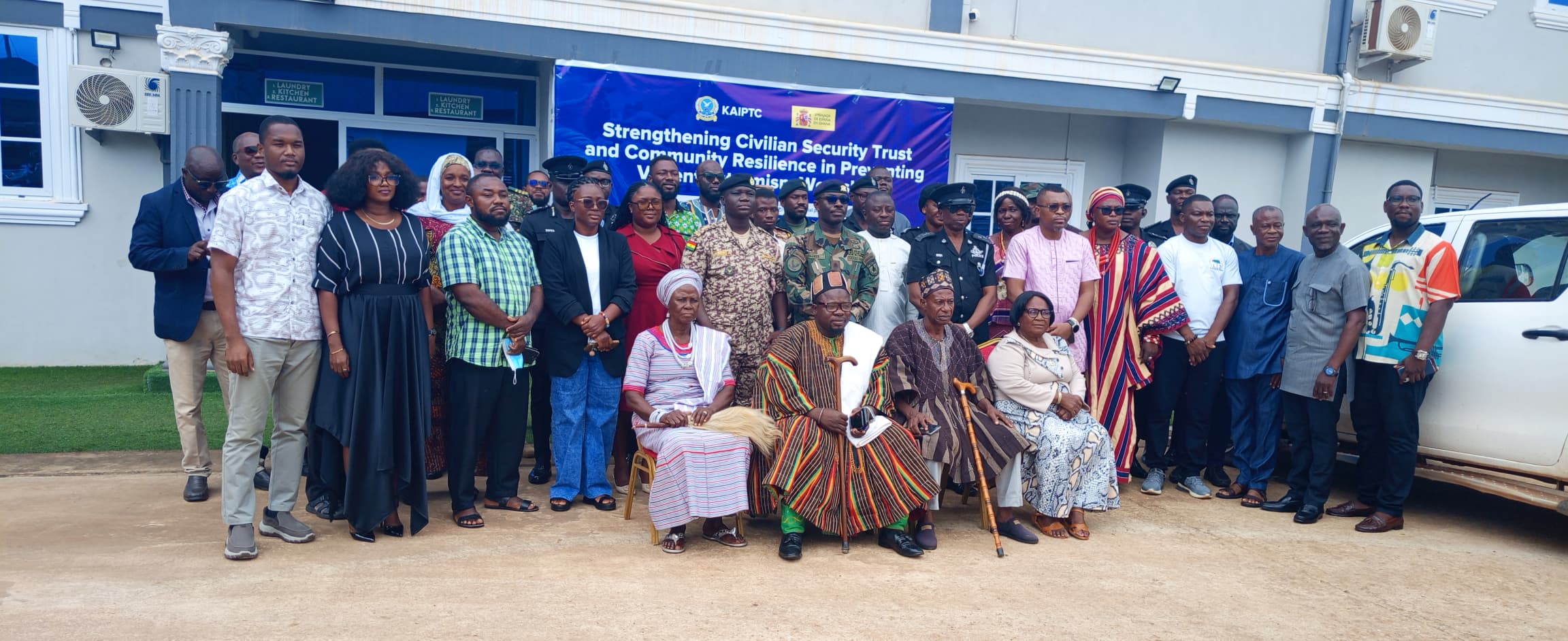
He said the workshop brought together 45 representatives drawn from civil society organisations, local government institutions, the Regional Coordinating Council, Metropolitan, Municipal and District Assemblies, traditional and religious authorities, among others.
Lt. Col. Palmer said security was no longer the sole responsibility of uniformed personnel, arguing that civilians play a critical role in providing information from communities.
“Security is not only in the hands of the uniformed people. It is the civilians who serve as the ears and the mouth in the communities.”
He explained that information gathered from communities enables security agencies to analyse emerging threats and make informed policy and operational decisions.
He said the programme, being implemented across four northern regions; Upper West, Savannah, North East and Upper East, seeks to equip participants with the knowledge and skills to strengthen community engagement and civilian-security cooperation.
Lt. Col. Palmer said participants were expected to go beyond discussions and develop practical regional plans that could be implemented in their respective communities.
“Your work has just begun. We are expecting from you what you put on paper, and when you go back, also implement.”
He said the programme would also establish a trained cohort of regional participants capable of facilitating similar community engagements after the conclusion of the workshop.
The ultimate goal, he said, was to strengthen trust, promote dialogue and encourage collaborative problem-solving between communities and security agencies.
By Ibrahim Abubakari Wangara