
In Part I of this article, Nana Kwaku Agyemang recollected incidents of arrests of cocaine traffickers in Ghana or whose operations are associated with Ghana.
Please read on:
The court cases eventually ended. The warning did not. Ghana had already been told that the drug trade had taken root and that the country was gaining a reputation as a transit point.
Yet almost two decades later, our name began appearing again in some enormous cocaine cases. One of the biggest, however, did not have to reach Europe before it was discovered.
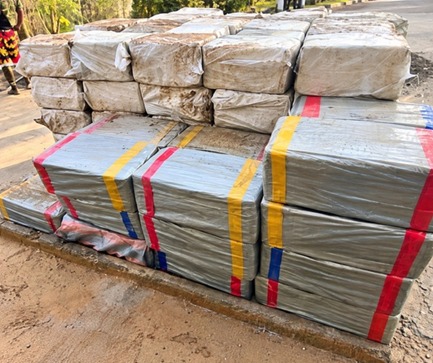
On 4 March 2025, National Intelligence Bureau operatives intercepted a tipper truck at Pedu Junction in Cape Coast while it was travelling from Takoradi towards Accra. Hidden beneath its load of sand were sacks containing cocaine. When the sand was removed, 143 sacks weighing 2,974 kilograms were recovered.
A follow-up operation four days later produced another 345.07 kilograms, taking the total to 3,319.66 kilograms, more than 3.3 tonnes. Subsequent testing by NACOC and the Ghana Standards Authority confirmed the substance as cocaine, with reported purity levels ranging between 50 and 70 per cent. The estimated value put on the haul was more than US$350 million.
Unlike Amsterdam or Dunkirk, there is no question here about whether the cocaine might have been inserted into a container somewhere after cargo had left Ghana. More than three tonnes of cocaine were physically intercepted on Ghanaian soil while being transported across the country.
The driver and his mate were arrested, other suspects were subsequently picked up and the case went before the High Court. By July 2025, Interior Minister Mohammed Muntaka Mubarak told Parliament that four other individuals had also been arrested and granted bail, while two prime suspects remained at large. The cocaine itself was eventually destroyed under a court order.
In June 2025 Dutch customs officers selected a shipping container for examination after it arrived at the port of Amsterdam from West Africa. Inside was timber. Hidden professionally amongst that timber was cocaine. Not 50 kilograms. Not 500 kilograms. About 4,500 kilograms; four and a half tonnes.
Dutch prosecutors described it as the largest cocaine seizure ever recorded at Amsterdam harbour. Customs had selected the container following a risk analysis and used scanning equipment and sniffer dogs during the examination. Initially the Dutch authorities described the timber simply as coming from West Africa.
As the investigation developed, something more emerged. In November 2025 the Dutch Public Prosecution Service disclosed that the timber had come from a company in Ghana and was destined for a company in Germany. Dutch investigators suspected that the German company was being used as a front for international drug transportation. A 69-year-old Amsterdam man was detained as part of the investigation while other suspects came onto investigators’ radar.
Saying that timber came from a Ghanaian company is not the same as saying that the Ghanaian company put cocaine into it. The publicly available Dutch information does not establish that. But the Ghana connection was no longer speculation. It had been stated by the Dutch prosecution service itself. And that wasn’t the end of 2025. In November Dutch authorities made another discovery at Amsterdam harbour.
This time it was a container carrying food products from Ghana destined for a company in the United Kingdom. Initially investigators thought they might be looking at more than 500 kilograms of cocaine. Further examination showed that some of the blocks contained something else.
The confirmed cocaine eventually amounted to more than 250 kilograms. The Dutch authorities also made a point that deserves attention: there was no indication at that stage that the British company receiving the cargo had anything to do with the drugs.
There is another side to this story that really bothers me. Ghana has never been particularly shy about identifying people arrested over cannabis. We have all seen the photographs: suspects in handcuffs, their names published, sometimes made to stand beside the cannabis they are accused of possessing or cultivating.
Yet when cocaine enters the picture, particularly cocaine involving serious money or people described as prominent, something seems to change. In February 2026, NACOC itself disclosed that a suspect had been arrested at Kotoka International Airport over an alleged attempt to export cocaine concealed in packaged gari.
The case immediately attracted attention because the person was initially described as a senior figure connected with a well-known Ghanaian food business. NACOC discussed the arrest publicly but declined to name the suspect. Seven months later, as I write this, I still cannot find an official statement telling Ghanaians who that person was, what charges were eventually brought against him or where the case now stands.
That is the comparison I find difficult to ignore. If an ordinary farmer is arrested with cannabis, we can see his face and read his name. Yet somebody can allegedly be arrested at Ghana’s international airport in connection with cocaine concealed in food products and months later we still do not know who he is. Why?
There may be a perfectly legitimate explanation for NACOC withholding a name. If there is, tell us. Otherwise people will inevitably ask whether there is one standard for the ordinary Ghanaian caught with cannabis and another when an investigation begins moving towards people with money or connections.
This is why I am no longer satisfied simply to count the tonnes. More than 3.3 tonnes of cocaine intercepted at Pedu Junction, 4.5 tonnes discovered in Amsterdam, hundreds of kilograms elsewhere and now consignments appearing on different continents. Who is paying for all of this? Who owns it? Who arranges the shipments? Where are the financiers? A tipper-truck driver and his mate did not finance US$350 million worth of cocaine. Somebody did.
Ghana’s drug enforcement agencies must be prepared to follow that money and those connections wherever they lead. If they lead to wealthy businessmen, security officials, politicians or parliamentarians, then so be it. The evidence should determine who is investigated, not the person’s position in society.
Europe was not the only destination. In April 2026, Australian Border Force officers examining two shipping containers that had arrived at Sydney’s Port Botany from Ghana detected anomalies in cargo declared as bags of charcoal. Inside was approximately 320 kilograms of methamphetamine. Australian authorities put its estimated street value at A$296 million.
Three people were subsequently charged in Australia. This time there was no uncertainty about whether the containers had come from Ghana: Australian authorities specifically identified Ghana as their point of origin.
NACOC opened an investigation and, after three months of intelligence work with other security agencies, announced in June 2026 that it had arrested the suspected lead shipper in Accra. The Commission said investigations were continuing and further arrests were expected. So here was another international narcotics shipment involving Ghana’s export chain, and this time NACOC had arrested the man it suspected of leading the shipment from this end. It did not publicly name him.
In August 2026, the suspected cocaine once again did not have to reach Europe before somebody found it. On the evening of 5th August police acted on intelligence about activities at a warehouse within the Tema Harbour enclave. Sacks of gari were being loaded into a 40-foot container. Hidden among them, according to police, were 866 wrapped parcels containing a whitish substance suspected to be cocaine.
Three men were arrested at the warehouse: Dutch national Gilano Horwin and two Ghanaians, John Mensah Sabah and Alhaji Iddris Haruna. The Tema Regional Police Commander subsequently told journalists that the Dutch suspect had allegedly admitted that the consignment belonged to him and that the substance was cocaine. Police estimated its street value at US$6.928 million.
Police described the substance as suspected cocaine and said it had been sent for forensic examination, so I will leave it at suspected cocaine unless an official result says otherwise. But look at what police say they interrupted. This was allegedly happening at a warehouse within the Tema Harbour enclave. The parcels were concealed among gari. They were being loaded into a 40-foot container.
This was not cocaine discovered thousands of kilometres away after passing through a chain we knew nothing about. That operation was stopped here in Ghana! And then, barely a month later, came Dunkirk. French customs officers discovered almost 3.9 tonnes of cocaine at Dunkirk in September. The cocaine was divided into 167 bales and concealed in plastic waste.
The container had come from Ghana and was intended, at least in part, for Antwerp. The estimated street value was €225 million. French judicial police had already been targeting the criminal network alleged to be behind the shipment and an organised-crime investigation is under way.
The investigation has now reached Ghana itself. On 14 September, NACOC announced that it had arrested three people suspected of representing and facilitating in Ghana the activities of wanted Dutch trafficker Jos Leijdekkers, better known as “Bolle Jos”. All three were in custody.
In its initial announcement, NACOC did not name them, which matters because names and political affiliations were already circulating elsewhere. NACOC’s Acting Director of Public Affairs and International Relations, Francis Opoku Amoah, later said the suspects had been on the Commission’s radar for some time and that further arrests could follow, either in Ghana or abroad.
He said NACOC’s intelligence did not indicate that Leijdekkers himself had entered Ghana, but the Commission believes he has people working for or with him here. That takes the Dunkirk story further than simply finding Ghana’s name on the paperwork of a container opened in France. Ghana’s own narcotics agency is now investigating people it believes may have been facilitating the activities of an international trafficking network from inside the country.
There has now been a significant development which must be acknowledged. For the first time in this investigation, names have emerged beyond the familiar driver-and-mate level. Media General has identified four accused persons as Desmond Koranteng, Musah Atta, Kwaku Okyere and Jessica, identified as Kwaku Okyere’s wife.
That is a step forward from NACOC’s initial announcement, when the suspects were left unnamed, and it would be unfair to pretend otherwise. But naming alleged facilitators is not the same as identifying the people who financed or ultimately owned nearly four tonnes of cocaine worth an estimated US$261.45 million. Those named are entitled to the presumption of innocence, and the evidence against them must be tested.
The larger question therefore remains exactly where it was: who supplied the money, who owned the consignment, who controlled the operation and who stood to collect the proceeds? Until that level of the network is exposed, Ghana may have moved beyond the driver and the mate, but it has not yet reached the financiers.
The Dunkirk container did not materialise in France. It has a history. Somebody supplied the plastic waste, somebody packed the container and somebody transported it into the shipping system. There will be records for the exporter, consignee, container, vessel and route. Ghana should be able to establish where it was packed, when it was sealed, how it reached the port and what happened to it before it left our shores.
Most importantly, investigators need to establish where the cocaine entered it. If it was already there when the container left Ghana, we have a very serious problem. If it was put in somewhere else along the route, that is a different story. We do not yet know which happened. That is precisely why we need the investigation rather than political conclusions being written before the evidence arrives.
There is something else about the quantities involved that should seriously equally bother us. These are enormous consignments. Whatever organisations ultimately prove to be behind them are operating on a scale that bears little resemblance to the old image of the individual drug courier swallowing pellets and boarding an aircraft.
Moving cocaine by the tonne requires an international operation. Somebody has to obtain it. Somebody has to finance it. Somebody has to move it. Somebody has to conceal it. Somebody has to get it into the commercial transport system. And somebody at the other end has to be ready to receive it.
The exact people doing those things are what investigators must establish. We should not fill the gaps for them. But Ghana should certainly be interested in what they find. Perhaps that is what makes the MV Benjamin case worth revisiting now. Not because of nostalgia and certainly not another opportunity to drag old political names back into today’s arguments. Its importance is that Ghana was warned.
We knew twenty years ago that international cocaine traffickers were using this country, and we knew they were not doing it alone. There was Ghanaian involvement. We knew large quantities could be moved through our waters and that organised criminals had found weaknesses they could exploit. We knew enough to establish a national inquiry, prosecute suspects and send people to prison. So the question in 2026 cannot be whether Ghana knew.
We knew. The question is what we did with that knowledge. And the answer, looking at where we are twenty years later, is very little. There will be a temptation to turn Dunkirk into another NDC versus NPP fight. Names will be thrown around, accusations answered with counter-accusations and before long the drugs themselves will almost become secondary. But this problem has survived governments.
Cocaine traffickers do not need a party card to know where money can be made or weaknesses exploited. Ghana needs to know whether there is a weakness in the export chain. If there is, find it. If criminal networks have penetrated legitimate businesses, expose them. If containers are being contaminated after exporters surrender control of them, establish where. And if officials are involved, prosecute them.
That is also why Rev. John Ntim Fordjour’s intervention needs some historical perspective. The Ranking Member on Parliament’s Defence and Interior Committee has described the present situation as an “unprecedented” narcotics crisis and the Minority says seizures linked to Ghana under the present NDC administration exceed US$1 billion.
He is asking an important question: where are the financiers and principal traffickers? He has also called for a parliamentary inquiry. But this story did not begin in January 2025.
Twenty years ago, under an NPP government, Ghana was dealing with the MV Benjamin, 76 missing sacks of cocaine and the arrest abroad of a sitting NPP MP who was eventually imprisoned for heroin trafficking. What Fordjour is demanding today is what Ghana should have demanded relentlessly from every government since then: find the people behind the trade, however powerful or politically connected they may be.
None of this means we should guess who is behind these consignments. Investigate and find out. Follow the money, the companies, the shipping arrangements and the people providing access.
If that trail leads to powerful businessmen, security officials, politicians or parliamentarians, follow it there too. Ghana cannot continue catching people around the edges while those financing, organising or protecting the trade remain beyond reach.
So investigate. Because twenty years after the MV Benjamin, Ghana should not still be waiting for customs officers thousands of kilometres away to tell us what may have travelled through our own maritime trade. Nearly four tonnes of cocaine have just been found in France inside a container that came from Ghana.
Before this becomes yesterday’s news, somebody needs to follow that container all the way back. And this time Ghana should not be satisfied until we know where the trail begins and equally where it ends, because after twenty years of this, there is an uncomfortable question we can no longer avoid: are we merely being used by international drug traffickers, or have we become part of the business?
Nana Kwaku Agyemang